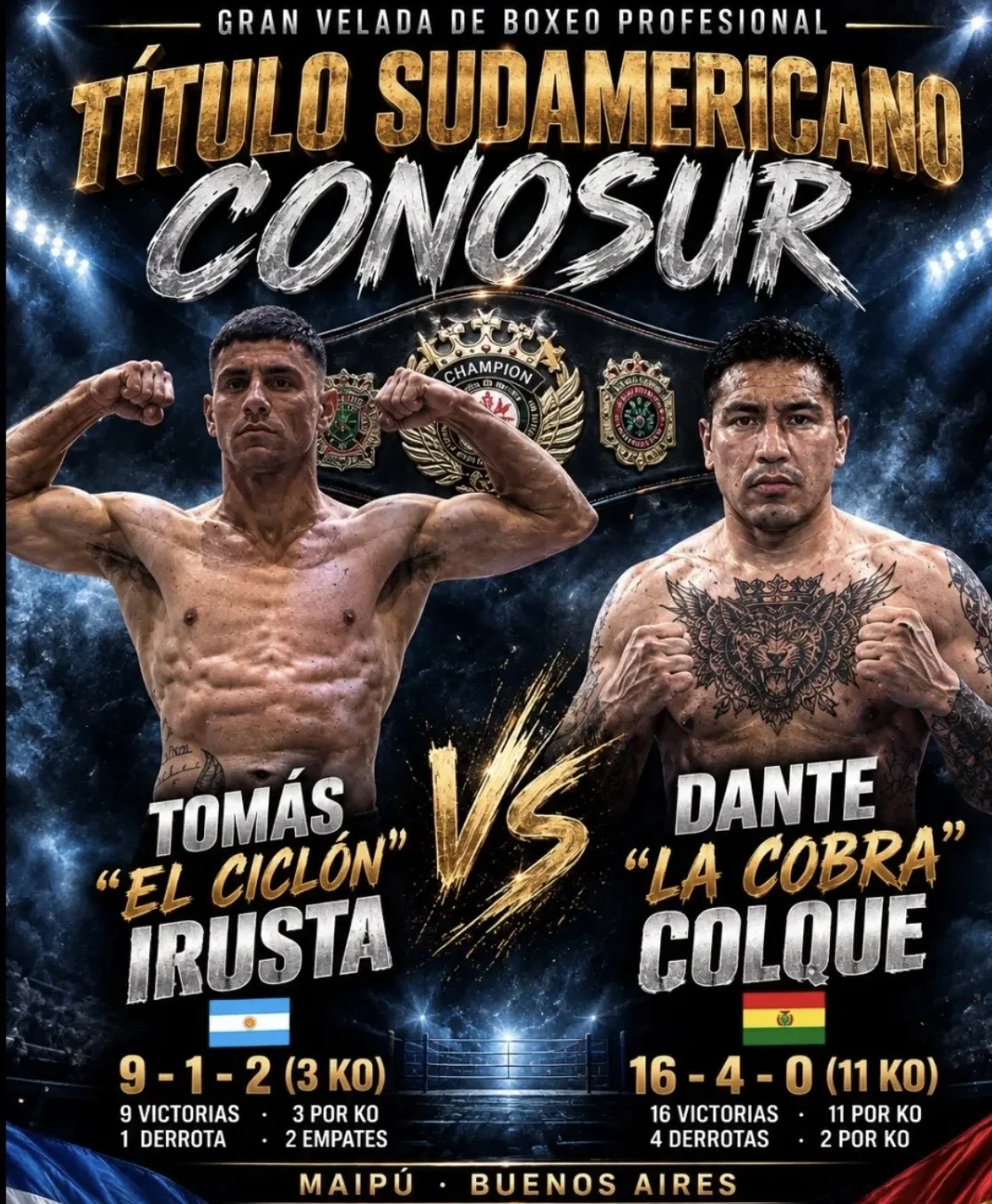
The regional super lightweight division is set for a dramatic and explosive showdown this Friday, October 16, as Club Jorge Newbery prepares to host a high-stakes championship battle in the 140-pound weight class. In a contest that promises an intriguing clash of opposing ring philosophies, Tomás Fermín Irusta will go toe-to-toe with Dante Colque for the vacant World Boxing Association (WBA) Fedelatin Southern Cone super lightweight title. With both fighters eager to claim a recognized regional belt and elevate their profile within the pioneering sanctioning body, the upcoming bout carries immense career significance for both contenders. The matchup pits the refined, technical ring generalship and disciplined defensive mechanics of Irusta directly against the ferocious, high-intensity pressure and physical grinding style of Colque, establishing the foundation for a compelling night of professional boxing where tactical adherence, physical endurance, and mental toughness will be pushed to the limit.
Regional title bouts under the banner of the World Boxing Association serve as critical stepping stones for ambitious pugilists seeking to advance beyond domestic competition and earn recognition within the global sanctioning hierarchy. The vacant WBA Fedelatin Southern Cone super lightweight title offers far more than a tangible championship belt; it provides the victorious fighter with vital leverage in the sanctioning body’s regional ranking structure, creating opportunities for larger fight nights and higher-profile matchups down the line. Competing at the 140-pound limit—a division renowned for its demanding blend of speed, punch resistance, and relentless pace—holding a regional championship validates a boxer’s readiness to compete at an elite level. For both Irusta and Colque, Friday’s fight represents a defining moment in their respective journeys, with the winner stepping into the spotlight as a recognized champion and the loser facing the challenging task of rebuilding momentum in a notoriously competitive weight class.
Approaching this high-stakes opportunity with a calculated mindset, Tomás Fermín Irusta enters the ring with a tactical blueprint built upon technical precision and strategic ring control. Irusta has developed a fighting identity anchored by composure, steady positional awareness, and sound defensive fundamentals. Rather than allowing himself to be drawn into wild, unpredictable firefights, Irusta consistently prefers to command the action from the center of the canvas, operating as a disciplined ring general who controls the distance and dictates the overall rhythm of the bout. His primary objective against an aggressive opponent like Colque will be to establish early control of the center ring, utilizing a sharp, persistent jab as both an offensive weapon and a primary defensive barrier. By keeping his jab active and accurate, Irusta can establish his preferred range, disrupt Colque’s forward momentum, and score cleanly while staying outside the range of incoming power shots.
In addition to his jab work, Irusta’s defensive framework depends heavily on fluid, purposeful lateral footwork. Rather than backing up in straight lines—which would allow a forward-marching pressure fighter to easily trap him against the ring barrier—Irusta relies on precise pivoting and lateral movement to circle away from danger and reset his stance in open space. This continuous movement forces his opponent to reset their feet, disrupting their rhythm and causing them to expend valuable energy pursuing a target that refuses to stay static. Once Irusta successfully establishes his distance and forces his rival into a state of chasing, his offensive blueprint calls for launching crisp, straight-punch combinations aimed directly through the center of his opponent’s guard. When an aggressive fighter drives forward to unleash heavy hooks, natural openings present themselves down the middle; Irusta’s ability to recognize those gaps and fire straight lefts and rights through the guard will be instrumental in banking rounds and enforcing his authority over the fight.
Standing in stark contrast to Irusta’s methodical approach is Dante Colque, a fighter whose entire style is defined by aggressive temperament and an appetite for grueling, physical battles inside the ring. Colque is not a fighter who relies on long-range boxing, patient point-scoring, or prolonged tactical standoffs from the perimeter. Instead, he approaches combat with an uncompromising, forward-marching mindset designed to transform every contest into an intense test of physical endurance and durability. Colque recognizes that his greatest advantages lie in close-quarters warfare, where he can turn the bout into a physical grind, smother his opponent’s long-range attacks, and break down their defensive posture through sheer aggression and heavy work inside the pocket.
Colque’s primary tactical imperative on Friday night will be to close the gap rapidly, cut off the ring effectively, and deny Irusta the open space needed to execute his movement-based game plan. To achieve this, Colque must employ consistent, intelligent forward pressure, stepping across the canvas to block off escape routes and force Irusta backward toward the ropes or into the corners. Once he succeeds in closing the distance and crowding his opponent, Colque’s offensive firepower comes to life through relentless combinations in close quarters, with a particular emphasis on hard, punishing hooks to the body. Targeting the midsection is a classic and proven strategy against mobile, technical fighters; by landing heavy body shots early and often, Colque will look to sap Irusta’s cardiovascular reserves, slow down his foot movement in the middle and late rounds, and weaken his overall defensive integrity. Colque’s willingness to walk through initial resistance to deliver his own power shots makes him a formidable opponent, and his primary goal will be to turn the contest into a high-tempo war of attrition that neutralizes Irusta’s technical capabilities.
The contrast between Irusta and Colque creates a classic stylistic dynamic that has fascinated boxing observers throughout the history of the sport: the classic matchup between the technical boxer-runner and the aggressive, ring-cutting swarmer. The outcome of the contest will largely depend on which fighter successfully enforces their preferred fight environment. If Irusta can maintain tactical discipline, stay calm under fire, and keep the contest located in the center of the ring, the fight will likely favor his balanced, movement-oriented skill set. By repeatedly circling out of danger, pumping the jab, and firing straight combinations whenever Colque steps forward, Irusta can establish a dominant pattern, picking up rounds through technical efficiency while minimizing the damage taken from Colque’s power punches.
Conversely, if Colque can successfully break through Irusta’s jab, cut off the canvas, and trap his opponent against the ropes, the dynamic of the bout will undergo a radical transformation. When pinned along the ring enclosure, a movement-based fighter loses their primary defensive asset—space—and is forced into static, high-risk exchanges inside the pocket. In a toe-to-toe battle along the ropes, Colque’s superior comfort in chaotic physical warfare, combined with his body hooks and relentless punch volume, could heavily tilt the scales in his favor. Under those conditions, the fight becomes unpredictable, grueling, and electrifying, putting Irusta’s durability and defensive composure under severe strain.
Beyond their physical and technical attributes, both fighters will face demanding tests of cardiovascular conditioning and mental fortitude throughout the fight. For Irusta, maintaining fluid footwork, precise timing, and continuous jab production over multiple championship rounds requires supreme physical conditioning and unbroken concentration. A single split-second distraction or a sudden drop in foot speed could allow Colque to penetrate his guard and force a firefight. Irusta must remain entirely composed, avoiding the temptation to trade heavy punches emotionally when Colque manages to land solid blows or apply heavy physical pressure.
For Colque, the challenge centers on maintaining an unrelenting pace without becoming overly reckless or vulnerable to sharp counterpunches. Ingesting straight shots down the middle while advancing requires remarkable toughness, and if his early efforts to corner Irusta are neutralized by smart lateral movement, Colque must avoid growing frustrated or sloppy. His success will rely on varying his forward approach, throwing punches while stepping inside, and relentlessly targeting Irusta’s body to gradually wear down the technician’s legs as the rounds progress.
The setting at Club Jorge Newbery adds another layer of excitement to this regional championship fixture. Intimate, traditional boxing venues create an atmosphere where the crowd’s energy directly impacts the fighters inside the ring. With spectators seated close to the action, every crisp jab, thunderous body blow, and dramatic exchange along the ropes will resonate throughout the venue. The passion of the audience on Friday night will undoubtedly heighten the dramatic tension, inspiring both super lightweight contenders to dig deep into their physical reserves as they pursue regional glory.
As the fight date arrives, anticipation continues to build surrounding this compelling 140-pound championship clash. The vacant WBA Fedelatin Southern Cone super lightweight title represents a transformative opportunity for both Tomás Fermín Irusta and Dante Colque, offering the victor international recognition and a clear path forward in their professional career. Whether the night culminates in a masterclass of defensive posture, jab control, and tactical footwork by Irusta, or a ferocious display of non-stop forward pressure, body attacks, and physical dominance by Colque, this showdown at Club Jorge Newbery possesses all the elements required for a memorable night of championship boxing.