

For decades, the global boxing equipment landscape has been divided into rigid territories. The sport’s upper echelon has long looked to Japan for peerless hand safety and clinical finishing, to Mexico for firm, puncher-centric horsehair traditions, or to established Western conglomerates that market mass-produced gear manufactured across South Asia. Pakistan, despite serving as the world’s most prolific manufacturing hub for sporting goods, historically carried a persistent stigma among purists, often associated with derivative designs, rigid cuts, and inconsistent quality control.
That prevailing sentiment, however, has faced a notable challenge over the past decade through the rise of TopBoxer. Operating out of Pakistan and steered directly by glovemaker Muhammad Irfan, the company established a devoted following across online combat sports communities like Sherdog, with professional fighters and seasoned amateurs alike praising its bespoke craftsmanship.
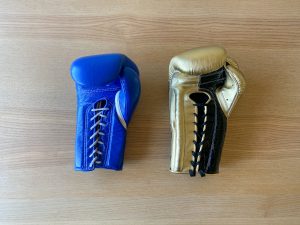
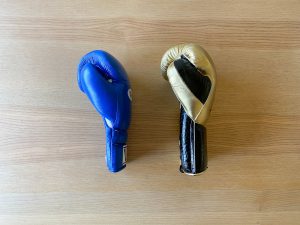
Following a full year of testing involving two distinct pairs—a fully customized 16-ounce training glove and a stock 14-ounce bag glove—a comprehensive picture emerges of how TopBoxer is reshaping expectations around boutique glove making, accessible custom manufacturing, and fighter safety.
The Rise of Muhammad Irfan and TopBoxer
The narrative surrounding TopBoxer began circulating around 2016, a period when boutique combat brands were proliferating online. Yet while most emerging labels relied on private-label mass production—buying generic catalog patterns from Pakistani factories and rebranding them with inflated price tags—TopBoxer took the opposite trajectory. Muhammad Irfan presented himself not as a corporate figurehead or marketing strategist, but as an accessible craftsman willing to discuss padding densities, leather choices, and wrist geometries directly with buyers.
In the combat sports gear market, company proprietors typically fall into one of three profiles:
- The Marketer: Driven by promotional angles, buzzwords, and surface-level features designed to capture impulse buyers.
- The Business Operator: Focused strictly on unit economics, wholesale export volumes, and production margins.
- The Dedicated Craftsman: An artisan passionate about structural patterns, the physics of foam composition, cutting techniques, and the underlying mechanics of hand protection.
Engagements with Irfan revealed an artisan eager to deconstruct the trade. Discussions ranged from the behavior of layered foams under repeated impact to specialized structural stitching and tailored wrist ergonomics.
Perhaps most striking to prospective buyers was the cost proposition. Historically, custom-made gloves required navigating middle-men or ordering from boutique Mexican workshops without direct communication, often battling language barriers and unpredictable production queues. Irfan introduced a model where a fighter could correspond one-on-one with the actual maker, personalizing everything from foam density and wrist padding to embossed textures, for roughly $100 to $150.
The Path to the 2019 Order
The path to putting TopBoxer gear into active gym service involved an unexpected two-year delay. An initial consultation with Irfan in 2017 centered on an ambitious bespoke glove incorporating exotic crocodile leather. However, discussions surrounding the ethical implications of using farmed reptile skins prompted a pause on the order.
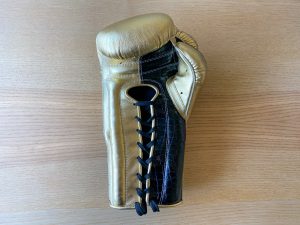
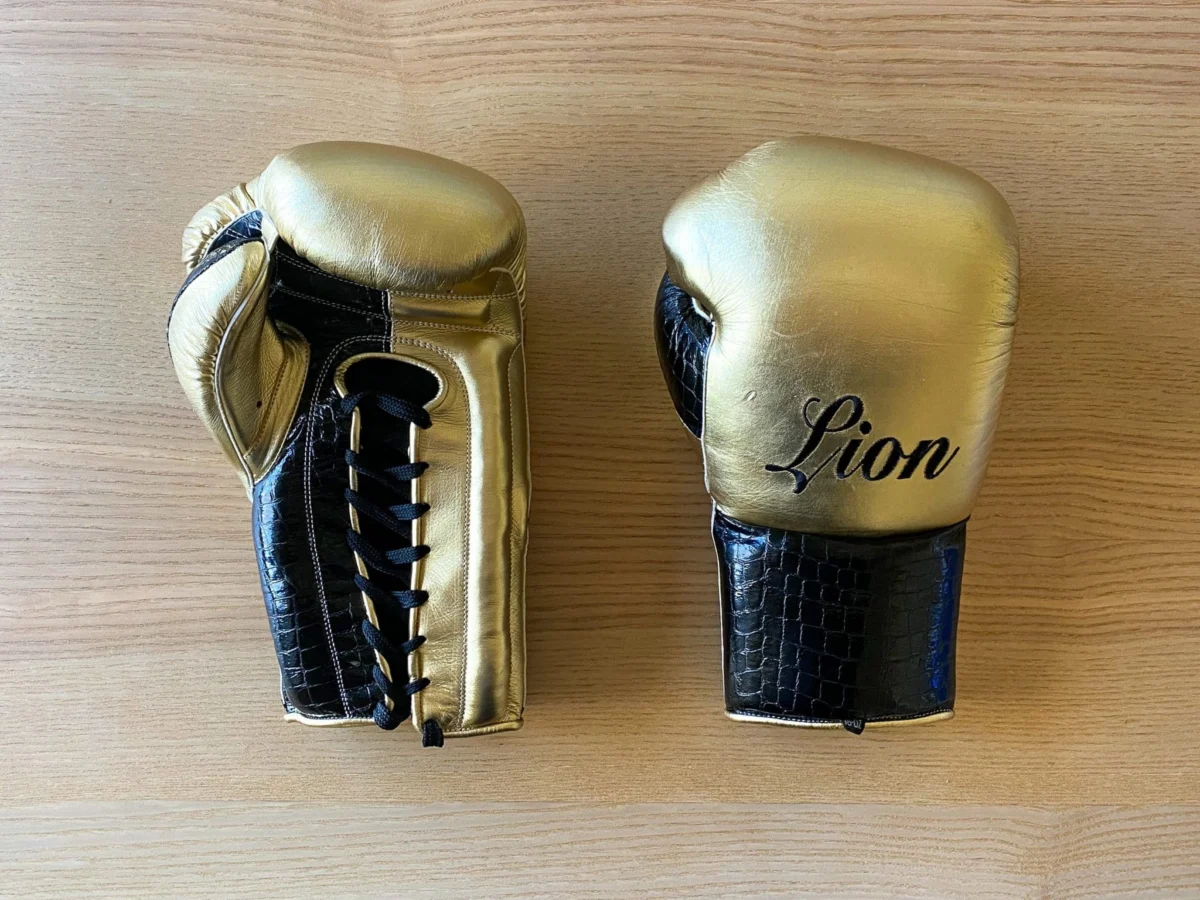
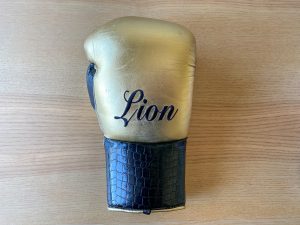
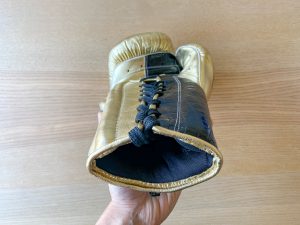
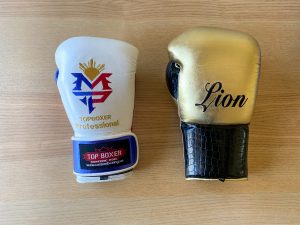
By 2019, an ethical compromise was reached: ordering custom gloves built with crocodile-print embossed cowhide leather rather than genuine reptile hide. The final order consisted of two contrasting configurations to test the breadth of TopBoxer’s manufacturing capabilities:
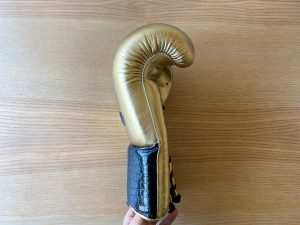
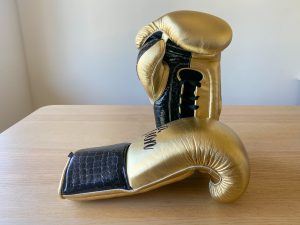
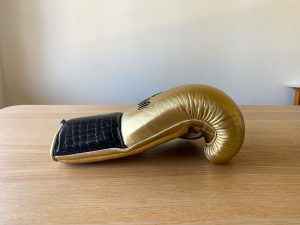
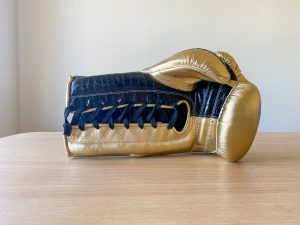
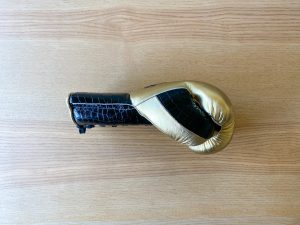
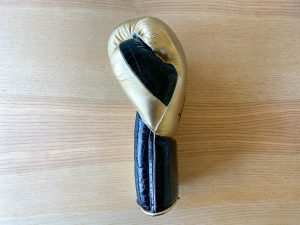
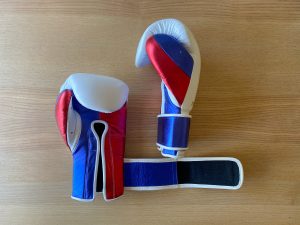
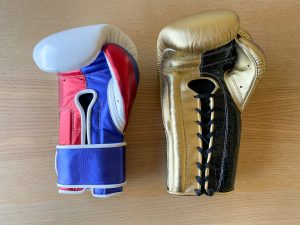
- A bespoke, lace-up 16-ounce training glove constructed with high-volume protective padding, metallic accents, and embossed print.
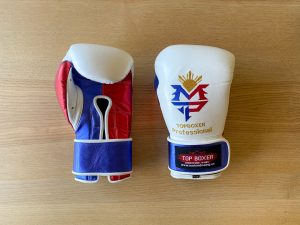
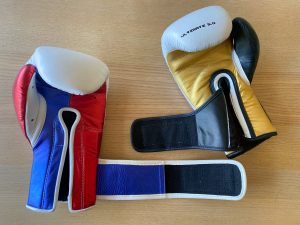
- A standard, stock 14-ounce velcro training glove designed for daily technical work and bag sessions.
Once delivered from Pakistan, both models were subjected to extensive gym usage, sparring, and bag rounds over a 12-month period.
Construction, Materials, and Ergonomic Design
An inspection of both pairs reveals an intriguing balance between traditional workshop assembly and specialized design touches.
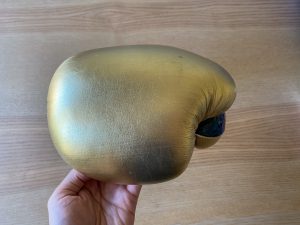
+--------------------------------------------------------------------------------+
|                         TOPBOXER GLOVE SPECIFICATIONS                          |
+-------------------+-----------------------------+------------------------------+
| Metric            | Custom 16-oz Lace-Up        | Stock 14-oz Hook-and-Loop    |
+-------------------+-----------------------------+------------------------------+
| Primary Material  | Croc-print / Metallic Hide  | Smooth Top-Grain Leather     |
| Piping            | Rolled leather welt         | Rolled leather welt          |
| Stitching Style   | Reinforced structural runs  | Tight dual-machine stitch    |
| Padding Target    | Maximum shock absorption    | Medium-density bag work      |
| Palm Structure    | Outer blade kick-shield     | Dual horizontal support bars |
| Thumb Geometry    | Curved "eagle-claw" hook    | Tapered straight profile     |
| Internal Cavity   | Broad / Roomy compartment   | Ergonomic / Snug standard    |
+-------------------+-----------------------------+------------------------------+
Leather and Piping
The leather displays the soft, slightly synthetic-sheen appearance characteristic of Pakistani tanneries. On the custom pair, the metallic gold finish and heavy croc-embossed texture largely obscure the natural grain, making long-term grain assessment secondary to finish durability. The stock 14-ounce pair, however, features smooth, natural leather that proves resilient over extended bag sessions without surface cracking. Both models incorporate rolled leather piping rather than synthetic trim, ensuring edges do not fray under repeated abrasion.
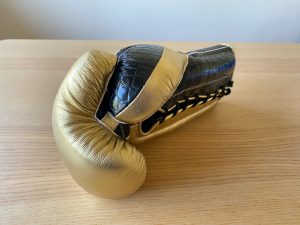
Structural Stitching
Stitching across both gloves is executed via machine with consistent, tight dual-stitch runs. Even after 100 to 200 rounds of intensive use, seam degradation and loose thread ends remain absent.
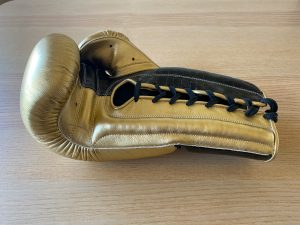
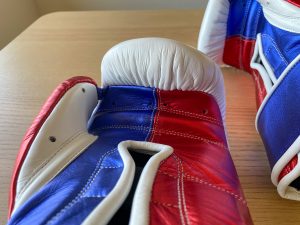
The custom pair features specialized structural stitching paths rarely seen on off-the-shelf gloves. Seam runs travel along the outer blade of the forearm down through the pinky knuckle, along the interior forearm into the thumb-wrist junction, and through the primary fist crease. These additions function as internal stabilizing ribs, distributing tension across the glove shell when tightening a fist.
Padding Architecture
Padding represents the starkest divergence between the two models:
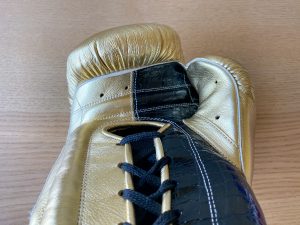
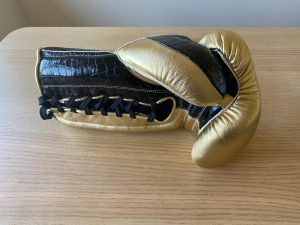
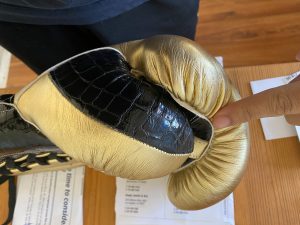
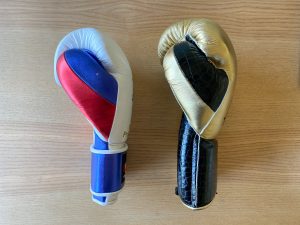
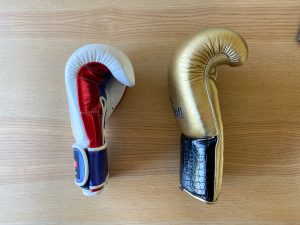
- The Custom 16-oz Model: Irfan delivered an exceptionally high-volume, pillow-like configuration. Despite its massive visual profile—often mistaken by gym observers for an oversized 20-ounce sparring glove—it weighs true to a light 16 ounces on the scales. An unusual padding strip sits on the palm side along the lateral hand blade, providing an extra shield useful for parrying or catching kicks.
- The Stock 14-oz Model: The stock model uses a conventional, medium-to-firm density padding stack balanced for bag work. On the palm side, Irfan incorporates two prominent padded horizontal bars across the wrist, providing rigid wrist support rarely found on entry-level gear.
Ergonomics and Thumb Shape
The stock 14-ounce glove showcases sophisticated ergonomic patterning. A distinct ridge runs along the back of the hand from the index finger down to the wrist, creating an anatomical contour that mimics natural wrist extension. This tailored contouring is typically found only on ultra-premium artisanal gear, such as bespoke Italian models by Di Nardo that sell for many times the price.
The thumb designs differ notably across the two pairs:
- The stock glove utilizes a contemporary, slim, tapered straight thumb that keeps the digit tucked parallel to the fist.
- The custom glove features a curved "eagle-claw" thumb hook reminiscent of traditional Mexican sparring gear, such as vintage Necalli gloves. While comfortable internally, the forward hook requires fighters accustomed to straight thumbs to adjust their fist closure slightly.
Performance in the Gym: Shock Absorption and Fit
Performance testing over the course of a year highlighted distinctive functional behaviors, especially regarding impact feedback and internal hand mechanics.
Fist Closure and Finger Posture
The custom glove employs an open-hand resting geometry. Rather than forcing the hand into a pre-curved, locked punch position—a hallmark of modern Mexican gloves—the fingers sit comparatively flat. This relaxed posture allows fighters to parry, manipulate the guard, and catch incoming shots with minimal forearm fatigue, closing the hand into a tight fist only at the moment of impact.
Hand Cavity and Fit
The internal compartment of the custom glove is notably wide. Even when built to custom dimensions, the hand chamber provides substantial lateral space. While vertical space is properly anchored—keeping the back of the hand snug against the padding—fighters with narrower hands must lace the wrists securely to prevent internal shifting. The stock 14-ounce glove, by contrast, features a universally accessible, balanced internal fit straight out of the box.
Knuckle Protection and Dampening
On the heavy bag and in live sparring, the custom glove provides near-complete impact dampening. Knuckle shock is deadened to a degree that rivals or exceeds industry-leading Japanese protection models like Winning:
- Standard training gloves deliver a sharp mechanical snap on impact, alerting the fighter to knuckle alignment.
- The custom TopBoxer setup absorbs almost all terminal vibration, muting the impact so heavily that heavy hooks land with a muffled thud rather than a crack.
For boxers managing chronic hand trauma, joint pain, or knuckle issues, this high-absorption density provides an uncompromising level of protection, eliminating post-workout wrist and hand soreness.
Head-to-Head: TopBoxer vs. Winning
Given that online gear forums often present TopBoxer as an economical alternative to Winning, an objective side-by-side comparison highlights the engineering trade-offs between a $150 bespoke glove and a $300 to $400 Japanese industry standard.
+--------------------------------------------------------------------------------+
|                        FEATURE & PERFORMANCE COMPARISON                        |
+-------------------+----------------------------+-------------------------------+
| Attribute         | TopBoxer Custom            | Winning Training Gloves       |
+-------------------+----------------------------+-------------------------------+
| Price Range       | ~$150 USD                  | ~$300 - $400+ USD             |
| Leather Grade     | Pakistani Cowhide          | Premium Japanese Cowhide      |
| Interior Liner    | Standard woven fabric      | Ultra-slick synthetic nylon   |
| Knuckle Cushion   | Ultra-high-volume dampening| Proprietary layered memory foam|
| Hand Ergonomics   | Semi-open, relaxed posture | Pre-curved anatomical fist    |
| Stitch Detailing  | Strong, slightly rustic    | Flawlessly spaced and aligned |
+-------------------+----------------------------+-------------------------------+
Winning retains a distinct advantage in production consistency, lining quality, and leather finish. The Japanese product features a refined, supple leather grain and a frictionless interior liner that allows hand entry without catching on wraps. Winning’s ergonomic fist curve remains the gold standard in balance and weight distribution.
TopBoxer, however, holds its ground in raw defensive capability. Its custom glove offers greater physical padding depth over the knuckles and far more extensive wrist and forearm protection on the palm side. While lacking the immaculate, millimeter-perfect manufacturing lines of Winning, TopBoxer matches its shock absorption at roughly a third of the investment.
Areas for Improvement
Despite its strengths, long-term testing revealed several areas where TopBoxer could refine its production process:
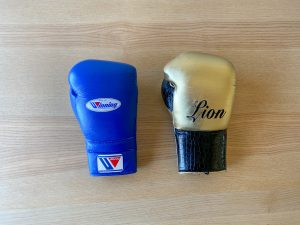
- Leather Surface Finishing: The custom pair arrived with tiny surface blemishes and minute chips in the metallic coating on the backhand. While strictly cosmetic and absent on the stock glove, premium-positioned bespoke equipment requires cleaner material prep and climate-controlled drying spaces.
- Padding Volumetrics and Seam Tension: The high-volume custom padding slightly distorts the glove’s profile near the wrist. Because standard pattern shells are filled with an extra-deep foam block, the leather stretches unevenly along the palm-side wrist welt, creating a visible outward bulge. Adjusting pattern dimensions specifically for oversized foam cores would improve structural clean lines.
- Thumb Anchor Geometry: On the custom pair, the leather web connecting the thumb to the index finger pulls downward slightly when curling a tight fist, forcing the thumb into an exaggerated bend. Adjusting the anchor angle or lengthening the web would provide a smoother transition from an open palm to a closed fist.
The Verdict
TopBoxer has played a pivotal role in democratizing bespoke boxing equipment. By pairing individual artisan access with low overhead costs, Muhammad Irfan carved out a unique space between generic mass-market gear and four-figure luxury gloves.
The stock 14-ounce model proves to be a durable, dependable everyday training tool that punches above its price class. The custom 16-ounce pair, meanwhile, offers exceptional impact protection and individualized styling for fighters dealing with hand ailments or seeking a personalized touch.
For athletes seeking high-grade, protective equipment without the high costs of imported Japanese or Mexican brands, TopBoxer represents an honest, protective, and uniquely tailored entry in modern combat sports manufacturing.