

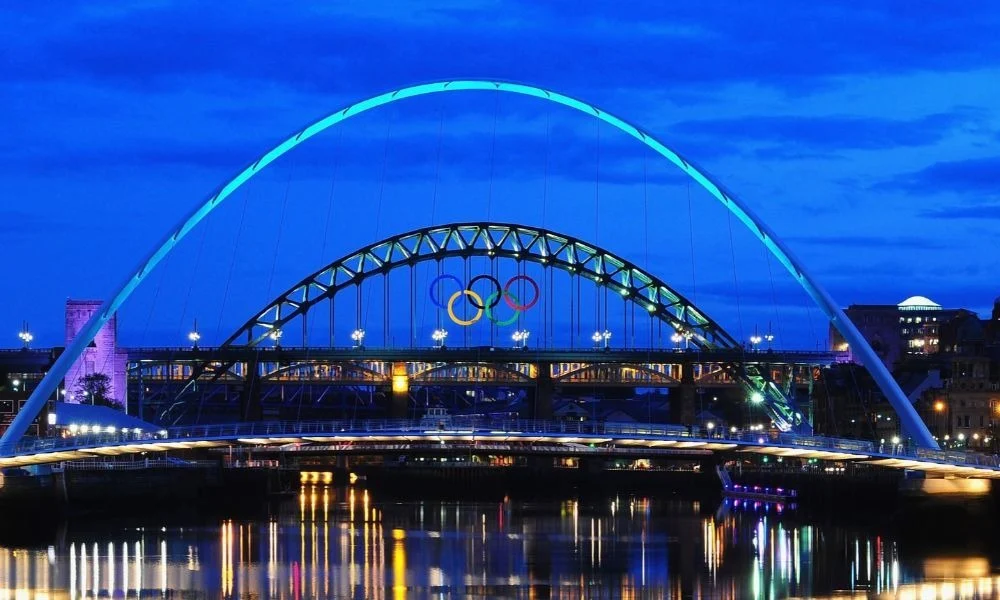
UK Sport has officially submitted a strategic assessment for a potential bid from the North of England to host the 2040 Olympic Games. However, the agency acknowledges that the rising cost of hosting major international sporting events has led to a much more considered and cautious approach regarding which projects it chooses to back.
The initiative follows a directive issued in May, when the UK government commissioned UK Sport to comprehensively evaluate the feasibility, associated costs, and potential long-term benefits of an Olympic and Paralympic bid centered around a multi-city hosting model. This proposed blueprint would span several major northern urban centers, including Manchester, Liverpool, Sheffield, and Newcastle, acting as a catalyst for a wider economic, infrastructural, and sporting regeneration project across the region.
Speaking to SportsPro at the SportAccord Forum in Lausanne, Esther Britten, UK Sport’s deputy director and head of major events and external affairs, confirmed that the initial exploratory work has now been completed. She suggested that the time is right to seriously evaluate the prospect of bringing the Olympic Games back to Britain, building upon the universally acclaimed and successful staging of the London 2012 Olympic and Paralympic Games.
Reflecting on the timeline, Britten noted that UK Sport had long maintained that partnering with the Olympic and Paralympic movement again before the 2040s was practically unfeasible. Consequently, she explained that engaging in this preliminary strategic look has been a fascinating and timely exercise. Describing it as a potentially long-term project, she emphasized that the strategic assessment has now been formally submitted, leaving officials to determine the appropriate next steps.
Britten characterized London 2012 as one of the greatest urban and social regeneration projects that global sport has ever witnessed. Those Games served as the shining crown jewel of a remarkable decade for British sport, which also saw the UK successfully host the men’s Rugby World Cup, the World Athletics Championships, and the men’s Cricket World Cup. In the years since, the country’s event portfolio has expanded further to welcome the Uefa Women’s Euros, multiple editions of the Commonwealth Games, and an extensive array of individual World and European championships across a diverse spectrum of sports.
Even as the prospect of a 2040 Olympic bid is being weighed, the United Kingdom boasts a remarkably healthy and robust pipeline of upcoming major sports events. This calendar includes the upcoming Euro 2028 football tournament, the Tour de France, and the Netball World Cup in Manchester, which was officially confirmed just a week prior. Furthermore, the UK currently stands as the front runner to secure the hosting rights for the 2035 Fifa Women’s World Cup, underscoring its enduring status as a trusted and reliable destination for world-class sporting spectacles.
To support this bustling calendar, the UK government has allocated a substantial funding package of £500 million, equivalent to approximately US$667 million, dedicated to aiding event delivery. Nevertheless, UK Sport maintains a rigorous framework for evaluation. Any bid that the agency supports must demonstrably meet a comprehensive range of strict sporting, economic, and societal criteria. As a result, certain potential events are deliberately deprioritised or rejected outright if their anticipated local and national impact is deemed insufficient to justify the considerable public expenditure required.
Elaborating on this shifting philosophy, Britten admitted that the organization has increasingly found itself compelled to decline hosting opportunities that once would have been embraced without hesitation. When she first assumed her role years ago, she recalled that saying no to an event was a rare occurrence. Officials operated under a general consensus that if a major continental competition, such as a European Championship in a given sport, had never been hosted in the UK before, the responsibility to step up was clear. Today, however, the calculus has fundamentally shifted, with financial realities frequently dictating that an event is simply too expensive for the nation to pursue.
One prominent race that UK Sport was particularly keen to win involved securing the hosting rights for the 2029 World Athletics Championships. Hopes within the organization were understandably high, fueled by the successful staging of the 2017 championships in London, repeated iterations of the Commonwealth Games across the country, and the impending 2026 European Athletics Championships in Birmingham. Despite these strong credentials and a concerted effort, London ultimately lost out to rival bids from Nairobi and Munich, meaning that the earliest available vacancy for the event is now 2033.
Acknowledging the fierce nature of the contest, Britten noted that the team understood from the very beginning that the bidding process would be intensely competitive. In an unusual strategic move, UK Sport decided to make an early public announcement regarding its intention to bid for 2029, even going so far as to disclose the specific funding package that had already been secured. This tactical maneuver was designed to deter or fend off international rivals early in the cycle, though Britten conceded that it ultimately failed to alter the outcome of the selection process.
At the same time, Britten expressed admiration for the broader health of the sport and the competitive landscape overseen by World Athletics. She highlighted the significance of having three major European capitals—Rome, London, and Munich—actively re-engaging in a bidding race for what she described as arguably the third-biggest sporting event in the world. Coupled with the historic opportunity to take the championships to Kenya for the very first time, Britten described the outcome as brilliant for World Athletics, viewing it as a testament to the exceptional work the governing body has done in developing and delivering a premier global property.
Reiterating that defeat is a relative rarity for the nation’s high-performance sports agency, Britten concluded by offering her congratulations to the successful bids from Kenya and Germany for securing the 2029 and 2031 editions respectively, acknowledging that while the competitive environment is tougher than ever, the global health of athletics remains exceptionally strong.