Former UFC middleweight champion Sean Strickland has publicly thrown his mixed martial arts career into question after revealing that severe physical fatigue, compounding injuries, and the lucrative financial allure of professional boxing have pushed him to consider walking away from the Octagon. The outspoken American fighter has voiced a strong desire to test his skills inside the ring under the banner of Zuffa Boxing, the sister promotion to the UFC. However, any potential code-switch faces a formidable structural barrier: UFC Chief Executive Officer Dana White’s firm policy against active mixed martial artists jumping back and forth between the two organizations.
Strickland’s sudden uncertainty regarding his combat sports career unfolded through a series of candid, filter-free posts across social media. The former middleweight kingpin openly confessed that the brutal grind of top-tier MMA training camps has pushed his body to its absolute limits, leaving him drained and questioning his passion for the sport that made him a global star. Believing that a transition to pure boxing would offer significantly greater financial rewards accompanied by far less physical wear and tear on his body, Strickland raised the prospect of walking away from MMA entirely—or even challenging his existing contractual obligations—to pursue a high-stakes boxing venture.
The Physical Toll and Financial Motivation
For years, Strickland has established a reputation as one of the most durable, relentless volume strikers in the UFC’s 185-pound division. Yet, behind the aggressive forward pressure and high-frequency striking lies an accumulation of grueling injuries and grueling training sessions that have taken a severe toll on his physical well-being. In his social media admissions, Strickland detailed the specific physical setbacks that have eroded his desire to continue competing under full MMA rules.
"Yall I think Im just frustrated because my body is crashing because MMA training is brutal," Strickland wrote to his followers. He went on to identify specific severe injuries, adding, "My heart just isnt in MMA anymore. Groin tear, AC joint separation. I just dont think my heart is in MMA anymore. Boxing there is more money and its significantly easier."
The physical demands of elite mixed martial arts require an athlete to prepare across multiple discipline spectrums simultaneously, including wrestling, Brazilian jiu-jitsu, kickboxing, and heavy strength and conditioning. That multifaceted regimen, combined with full-contact sparring and grappling exchanges, creates a continuous cycle of wear on the joint structures and muscle tissue. For Strickland, the contrast between that relentless grind and the specialized focus of boxing appears stark. In his view, transitioning to a single-discipline sport offers a path toward prolonged longevity, reduced injury risk in practice, and a substantial bump in compensation.
So deep is his frustration that Strickland went so far as to ponder whether he should force an exit from his current UFC contract in order to pursue a fresh start inside the boxing ring. "I haven’t decided if I want to nuke my contract," he admitted, "but I gotta say man putting hands on you sounds way better than the UFC right now….."
Championship Resume and Bold Boxing Claims
Strickland’s desire to cross over into boxing is not merely rooted in financial frustration; it is also driven by supreme confidence in his standing as a elite striker. Having fought at the absolute pinnacle of the UFC’s middleweight division, the former champion argued that his accomplishments in the Octagon earn him the right to chase major honors in the squared circle.
In a follow-up video, Strickland expanded on his reasoning, laying out his resume and asserting that his approach to fighting has effectively always been centered on boxing techniques.
"I fought for the title four times. I won it twice, beat all the boogeymen in the division. Hell, I fought half the division already," Strickland stated. "I want to box. I want to go put a f***ing boxing title on my mantle. I deserve it. I don’t even do MMA. I just box. I will put hands on any boxer."
Driven by that conviction, Strickland raised eyebrows across both the MMA and boxing communities by taking aim at high-profile targets in pure pugilistic competition. He expressed open interest in setting up a massive crossover event against YouTube personality turned professional boxer Jake Paul, while simultaneously setting his sights on the highest echelon of Zuffa Boxing itself—specifically targeting Zuffa Boxing cruiserweight champion Jai Opetaia, despite possessing no formal professional boxing matches on his record.
"If Jake Paul wants to give me a big old bag of money to fight him, I’m under contract," Strickland declared. "Fine, I’ll go to Zuffa. I’ll go beat your cruiserweight champ, easy."
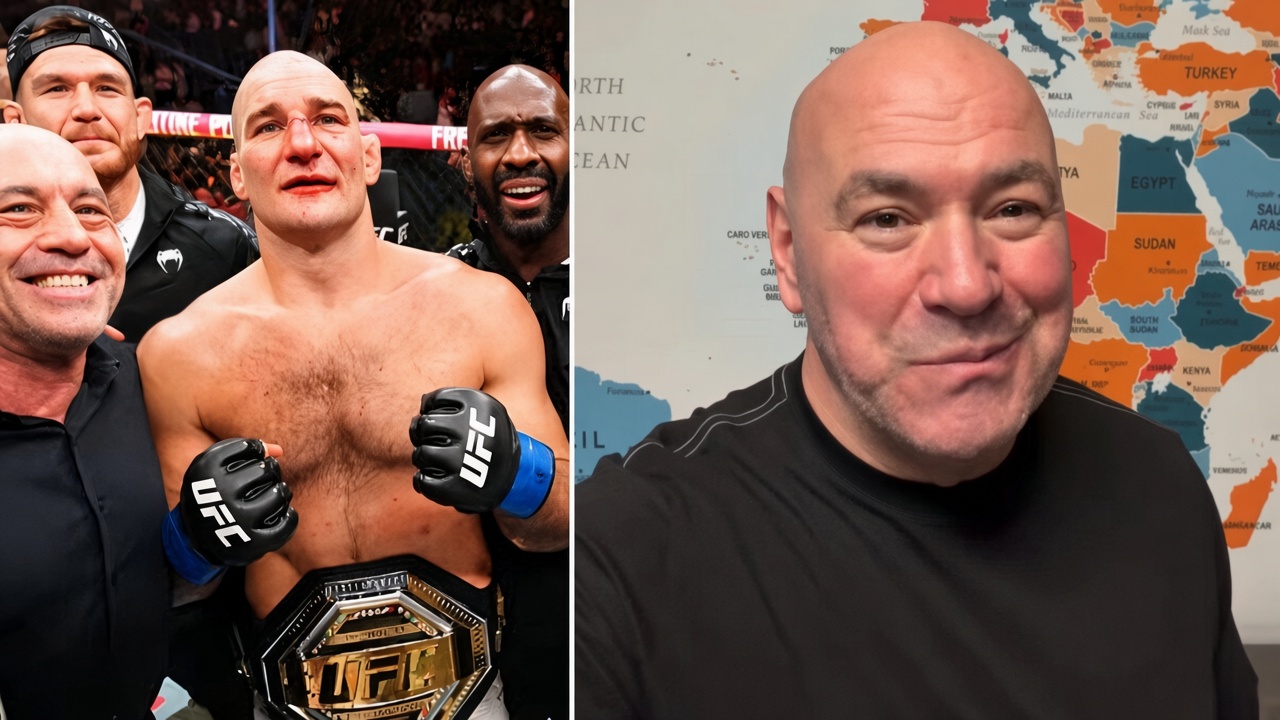
Dana White’s Boxing Ban
While Strickland’s willingness to disrupt the status quo makes him a unique figure in the combat sports landscape, his ambition to conquer Zuffa Boxing faces an immediate block from executive leadership. Dana White has consistently maintained a strict barrier preventing active UFC fighters from easily stepping into professional boxing rings, particularly under the Zuffa Boxing umbrella.
White’s hesitation to permit cross-promotion or multi-sport movement stems from clear operational and competitive logic. Mixed martial arts and professional boxing, while sharing overlapping elements of striking, represent fundamentally distinct combat disciplines. The distance management, stance, glove size, defensive shell mechanics, and pacing required in a twelve-round professional boxing match differ dramatically from the five-round, small-glove environment of the UFC Octagon.
History has repeatedly demonstrated a considerable technical gulf when elite MMA strikers face world-class professional boxers strictly within the confines of the squared circle. While Strickland’s volume jab and defensive shoulder-roll have proven devastatingly effective against mixed martial artists who must constantly worry about takedowns, kicks, and knees, applying those same tools against a pure specialist presents a radically different challenge.
The contrast between Strickland and Jai Opetaia highlights precisely why top executives remain skeptical of such crossovers. Opetaia is an established, world-class cruiserweight champion who has devoted his entire lifetime to mastering the footwork, rhythm, timing, and power delivery exclusive to elite boxing. Strickland’s self-belief and formidable toughness, while undeniable inside the Octagon, would be hard-pressed to bridge that deep technical divide against a seasoned, championship-level pugilist.
Consequently, White’s policy against cross-over participation serves to protect both the competitive credibility of his individual brands and the market value of his contracted UFC superstars. Allowing a top-ranked UFC contender to suffer a decisive defeat in a pure boxing bout risks diminishing their drawing power upon returning to the Octagon. For these reasons, White’s prohibition against UFC athletes switching at will to Zuffa Boxing is expected to remain firmly intact.
Strickland’s Next Move
Following his initial series of fiery social media rants and calls for contractual upheaval, Strickland appeared to take a step back to re-evaluate his position. The former middleweight champion subsequently addressed his fan base with a far more tempered posture, signaling that his outburst may have been more about venting immediate frustration than launching a formal breach of contract.
"Alright Im done being a bitch. Ill figure this out.. Sometimes talking to you degenerates just helps me work through thoughts," Strickland posted in a follow-up message to his followers.
This temporary de-escalation leaves Strickland’s immediate fight future hanging in a state of intriguing uncertainty. While his comments indicate that he is not making an instantaneous departure from the UFC, they also reveal a fighter who feels physically worn down by the rigors of mixed martial arts and increasingly attracted to the financial rewards available in professional boxing.
The ultimate question remains whether an athlete of Strickland’s stature can ever push White to soften his stance on cross-promotional bouts, or if Strickland will ultimately be forced to choose between seeing out his UFC contract or pursuing pure boxing outside the organization. Strickland has proved time and again that he is willing to push boundaries and test authority, but overcoming the corporate firewall between the UFC and Zuffa Boxing may prove to be the toughest battle of his combat sports career.
About the Author
Phil Jay is the Editor-in-Chief of World Boxing News (WBN) and a veteran boxing reporter with 16 years of experience. He has interviewed world champions, broken international exclusives, and reported ringside since 2010.