
When resistance training is discussed, the conversation almost universally defaults to dynamic movements. Traditional training is typically defined as a series of exercises—performed either dynamically or statically—that target specific muscle groups with adequate training volume, high effort, and consistency. Yet, conventional resistance training is predominantly dynamic, relying on isotonic muscle actions where a load is moved through a range of motion.

While dynamic lifting remains the cornerstone of strength and conditioning, the role of static, or isometric, training has long been overshadowed by conventional wisdom. Many fitness enthusiasts and athletes assume that isometric holds—such as planks or wall sits—cannot rival dynamic training for building strength and muscle hypertrophy. However, emerging scientific evidence suggests that this perception stems more from poor application than from any inherent limitation of isometrics. Setting the record straight requires examining how different muscle actions operate, what the literature reveals about strength and hypertrophy, and how isometric training stacks up against traditional dynamic modalities.

Understanding Muscle Actions
Before analyzing training modalities, exercise scientists distinguish between three primary types of muscle actions: isotonic, isometric, and isokinetic. The term "action" is preferred over "contraction" because muscle does not always shorten during tension.

Isotonic muscle actions involve constant tension while muscles undergo changes in length during dynamic movements. These actions consist of concentric components, where muscles actively shorten as actin and myosin filaments interact, and eccentric components, where muscles lengthen under an external load greater than the force produced by the muscle fibers. Together, these continuous dynamic phases form the backbone of traditional resistance training.

Isometric muscle actions, by contrast, occur without a meaningful change in the overall length of the muscle-tendon complex, even though internal fascicles may shorten while tendons elongate. Research indicates that maximal force capacity across muscle actions generally follows an eccentric-dominant order, where eccentric actions exceed isometric actions, which in turn exceed concentric actions. Eccentric actions are also more metabolically efficient and rely on internal elastic structures like titin, though both concentric and eccentric training robustly drive muscle hypertrophy.

Finally, isokinetic muscle actions involve constant angular velocity, typically measured using specialized dynamometers in clinical or research settings. While rarely used in general strength training, isokinetic testing provides objective assessments of strength for rehabilitation and neuromuscular research.

A Brief History of Static Strength
The roots of isometric training stretch back over a century, famously embodied by Russian-born strongman Alexander Zass, known professionally as The Iron Samson. Imprisoned during World War I, Zass reportedly maintained and built his formidable strength by performing repeated static tension efforts against cuffs, chains, and bars in his cell. Zass believed that static exercise, combined with dynamic movements, was essential for developing robust muscle and tendon strength.

Scientific inquiry into isometric training began in earnest in 1953 with German researchers Hettinger and Müller. Their landmark study had untrained participants perform daily six-second isometric contractions at roughly 67 percent of maximal voluntary contraction across various muscle groups. The researchers observed steady strength gains of about five percent per week, laying the groundwork for decades of subsequent physiological research.

Classifying Isometrics: Pushing Versus Holding
Isometric training is generally divided into two distinct categories: pushing, or overcoming isometrics, and holding, or yielding isometrics. Pushing isometrics involve attempting to move an immovable object, representing an unfulfilled concentric attempt. Holding isometrics involve resisting an external load to prevent joint movement, representing an unfulfilled eccentric attempt.

Recent meta-analytic evidence indicates that these two modalities elicit distinct physiological responses. Pushing isometrics can typically be sustained significantly longer than holding isometrics at the same relative intensity. Conversely, holding isometrics generate greater central processing demands, leading to higher perceived exertion, elevated heart rate, greater blood pressure spikes, and increased motor unit recruitment and rate coding. These differences suggest that holding isometrics rely on complex sensorimotor feedback and reactive control, whereas pushing isometrics depend primarily on pre-planned voluntary cortical control.

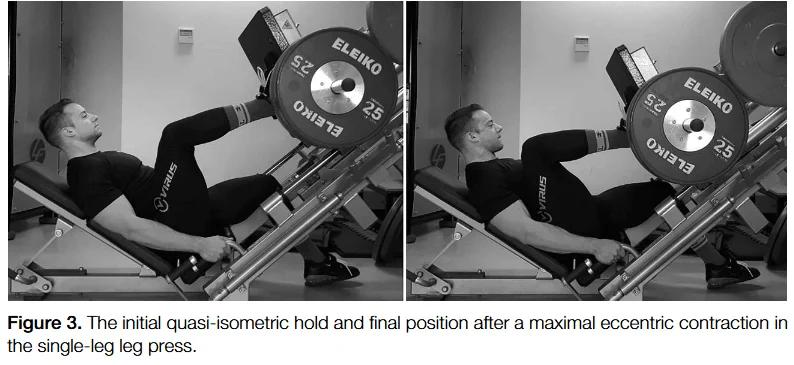
In practical applications, holding isometrics closely mirror the deceleration and loading demands often present during non-contact sports injuries, making them valuable in specific rehabilitative or injury-prevention contexts. Meanwhile, pushing isometrics excel at producing maximal force, making them well-suited for pure strength development. A hybrid variation known as eccentric quasi-isometrics begins as a holding isometric until fatigue forces a slow-velocity eccentric action, though long-term hypertrophic data on this specific modality remain limited.

Tendons, Pain Management, and Rehabilitation
In clinical and athletic rehabilitation, isometric training is frequently prescribed to manage tendinopathy and reduce pain. Tendons act as viscoelastic structures transferring muscular force to bone, adapting to mechanical overload through collagen synthesis, turnover, and increased tissue stiffness. Greater tendon stiffness correlates with superior force production, enhanced rate of force development, and improved sprint performance.

Research into exercise-induced hypoalgesia suggests that isometric contractions can provide acute pain relief, making them useful in the conservative management of tendon pain where dynamic loading might initially prove intolerable. While early studies sparked debate by claiming superior analgesic effects for isometrics compared to isotonic training, subsequent systematic reviews indicate that while isometric exercise is well-tolerated and effective for early-stage rehabilitation, its pain-relieving superiority over other training modes is not universally replicated. Nevertheless, heavy, controlled isometric loading remains a cornerstone for stimulating tendon adaptation and restoring function during recovery.

Muscle Hypertrophy and Architectural Adaptations
While rarely prioritized for bodybuilding, isometric training consistently drives muscle hypertrophy. Intervention studies spanning six to fourteen weeks demonstrate muscle cross-sectional area increases ranging from five to twenty-three percent.

A critical variable influencing isometric hypertrophy is muscle length. Evidence indicates that isometric training performed at longer muscle lengths yields greater hypertrophy, enhanced fascicle length changes, and superior shifts in the optimum torque-angle relationship compared to training at shorter lengths. These architectural shifts are theorized to result from the addition of sarcomeres in series, driven by high force production at extended muscle lengths where both active contractile elements and passive structures like titin contribute to total mechanical tension.

Training volume and intensity also dictate outcomes. Accumulating sufficient total contraction duration—often recommended between 80 and 150 seconds per session for hypertrophy—appears crucial. While moderate intensities around 50 to 70 percent of maximum voluntary contraction can stimulate growth if volume is adequate, higher intensities combined with shorter, explosive contractions are typically more effective for maximizing strength gains.

Comparing Isometric and Dynamic Training Directly
Direct head-to-head comparisons between isometric and dynamic training date back to the mid-20th century. Studies by researchers such as Rasch and Moorehouse, Kubo, and more recent trials confirm that both modalities yield comparable muscle hypertrophy.

While dynamic training often produces superior strength gains in dynamic 1-repetition maximum tests due to movement specificity, isometric training excels at increasing isometric strength and force production at targeted joint angles. Recent randomized trials comparing isometrics performed at long muscle lengths directly against full range of motion dynamic training have found similar overall regional quadriceps hypertrophy, reinforcing the conclusion that isometric training is a viable, highly effective alternative or supplement to traditional lifting.

Ultimately, while dynamic resistance training remains the most practical and comprehensive approach for overall physical development, isometric training offers powerful tools for targeting sticking points, managing tendon health, and stimulating muscle growth. By carefully manipulating variables such as contraction duration, joint angle, and training volume, athletes and practitioners can successfully integrate isometrics into a well-rounded physical conditioning program.