
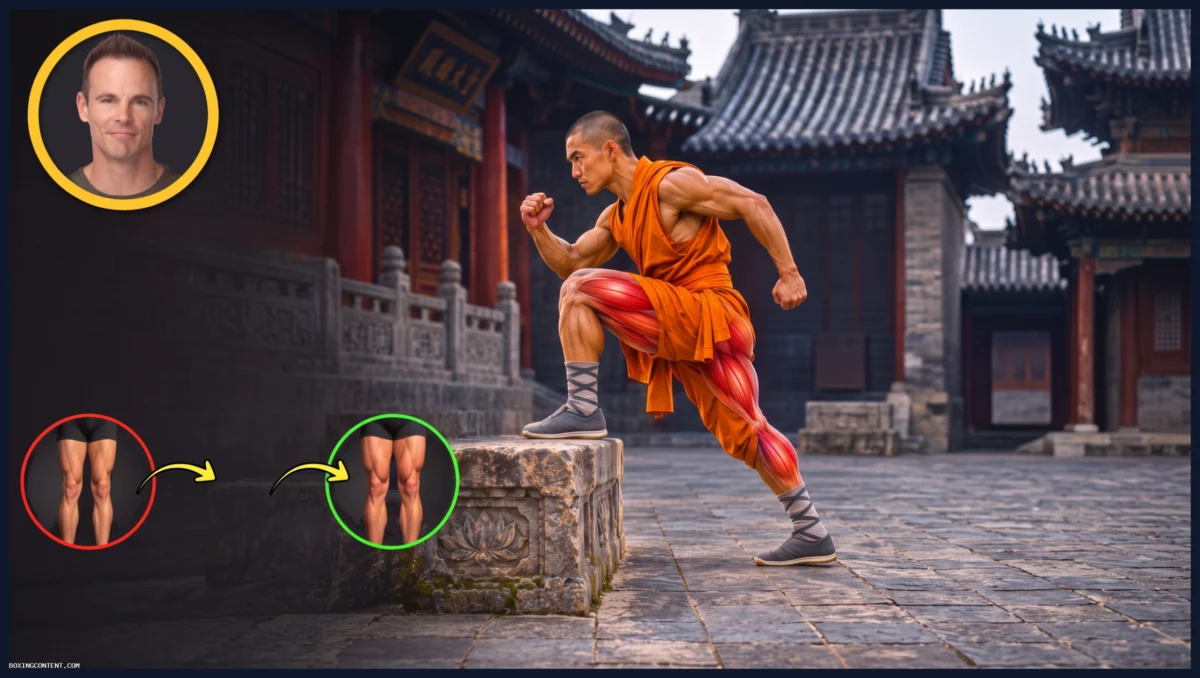
In the ever-evolving landscape of modern fitness, traditional barbell squats have long reigned supreme as the ultimate test and builder of lower-body strength. However, a recent viral video from a prominent fitness creator has sparked widespread debate across the fitness community by challenging this decades-long convention. Posing an uncomfortable yet thought-provoking question, the creator asked why human legs often remain vulnerable and weak precisely when real-life scenarios demand functional strength. His answer—drawing inspiration from ancient Shaolin martial arts traditions—challenges conventional gym programming and introduces a series of alternative movements designed to bridge the gap between gym-floor numbers and real-world durability.
Rather than relying solely on the linear, repetitive path of the traditional barbell back squat, the creator’s routine incorporates six distinct Shaolin-inspired leg movements, accompanied by two critical bonus exercises. While traditional weightlifting develops immense force in a controlled, predictable plane of motion, this alternative approach shifts the focus toward stability, hip mobility, positional endurance, and multi-directional control. Fitness experts note that while squats remain one of the most thoroughly researched and effective ways to develop raw leg power, incorporating these alternative mobility and stability drills can address overlooked physical gaps that standard routines frequently miss.
Why Squats Alone May Leave Gaps in Functional Strength
The core argument presented in the viral fitness video centers on the transferability of strength. The creator argues that strength built inside a single, highly repetitive pattern does not always automatically translate to the unpredictable physical demands of daily life. Activities such as climbing a steep flight of stairs while carrying heavy groceries, rising fluidly from a deep position on the floor, or reacting quickly to catch oneself after an unexpected misstep require a different kind of physical resilience.
Traditional squats excel at training prime movers in a sagittal plane, yet they can sometimes leave vulnerabilities in lateral stability, deep-range hip mobility, and sustained positional endurance. Sports scientists and physical therapists generally agree with the nuance of this observation. While traditional squats are undeniably effective for hypertrophy and absolute strength, treating unconventional bodyweight and mobility movements as complementary additions rather than outright replacements offers a safer, more balanced path to comprehensive physical fitness.
1. Horse Stance: The Isometric Foundation
The foundation of traditional Shaolin physical conditioning begins with an exercise that looks deceptively simple on the surface: the horse stance. Apprentices traditionally spent grueling hours building their foundational strength in this low, wide isometric hold. That description often sounds like an exaggeration to modern gym-goers until they attempt to hold the position continuously for two minutes, quickly discovering that their quadriceps, glutes, and adductors have very strong opinions on the matter.
In addition to building localized muscular endurance across the thighs and hips, the horse stance requires intense core activation to keep the torso upright and stable. Some proponents of isometric training credit these sustained holds with helping to lower resting blood pressure over time. While physiological research does support the cardiovascular benefits of isometric exercise, sports medicine specialists emphasize that these systemic improvements emerge from consistent, long-term practice spanning several weeks rather than a single isolated training session.
2. Duck Walk: Strength on the Move
Moving beyond static holds, the routine incorporates the duck walk, a dynamic movement that challenges the lower body through continuous motion under a deep load. As the fitness creator noted in his video, nobody looks particularly elegant moving in a deep crouch, even actual ducks. However, elegance is secondary to utility.
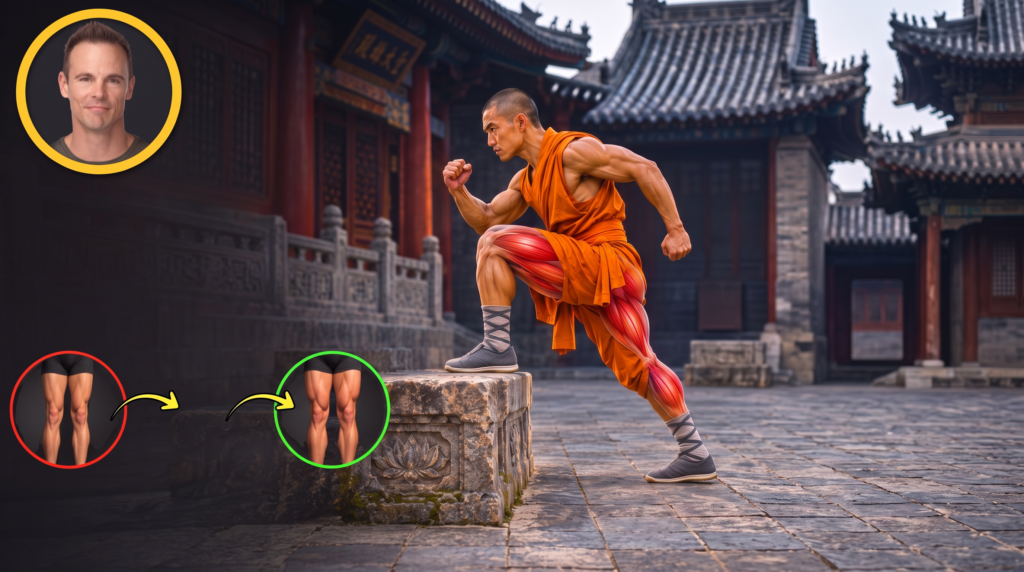
Unlike the standard up-and-down vertical path of a conventional squat, traveling in a deep crouch forces continuous side-to-side weight transfer while the leg musculature remains under constant tension. This lateral shifting demands active engagement from the stabilizing muscles of the hips, ankles, and knees, replicating the kind of unstable, loaded locomotion that humans rarely encounter when performing traditional barbell lifts inside a temperature-controlled commercial gym.
3. Frog Pump: Wake Up the Glutes
Every low, powerful base position utilized in martial arts depends heavily on the explosive power and endurance of the glutes. To target this crucial muscle group, the routine features the frog pump. By placing the soles of the feet together and allowing the knees to fall outward, this movement specifically isolates the gluteus maximus, which happens to be the largest muscle in the human body.
Strong, active glutes are essential for stabilizing the pelvis and protecting the lower back from undue stress during everyday lifting and moving. While some online fitness spaces claim that targeted isolation movements of this nature trigger massive spikes in post-exercise calorie burn, exercise physiologists advise caution, noting that while excess post-exercise oxygen consumption is a real physiological phenomenon, its overall caloric impact is typically modest.
4. Seated Hamstring Stretch
Flexibility has always been as central to Shaolin physical philosophy as raw power. Tight hamstrings can pull on the pelvis, creating an anterior pelvic tilt that places unnecessary strain on the lower back and limits functional range of motion. The seated hamstring stretch utilized in the routine focuses heavily on structural alignment.
As the creator emphasizes, the objective of the stretch is never to force the head down to meet the knees, but rather to maintain a neutral, straight spine while allowing the hips to lead the folding movement. While medical literature suggests that flexibility training alone has limited efficacy in preventing acute knee injuries, pairing static mobility work with active hamstring strengthening—such as the step-ups and frog pumps included in the broader routine—creates a much more robust framework for joint health.
5. Step-Up: Fixing the Weaker Side
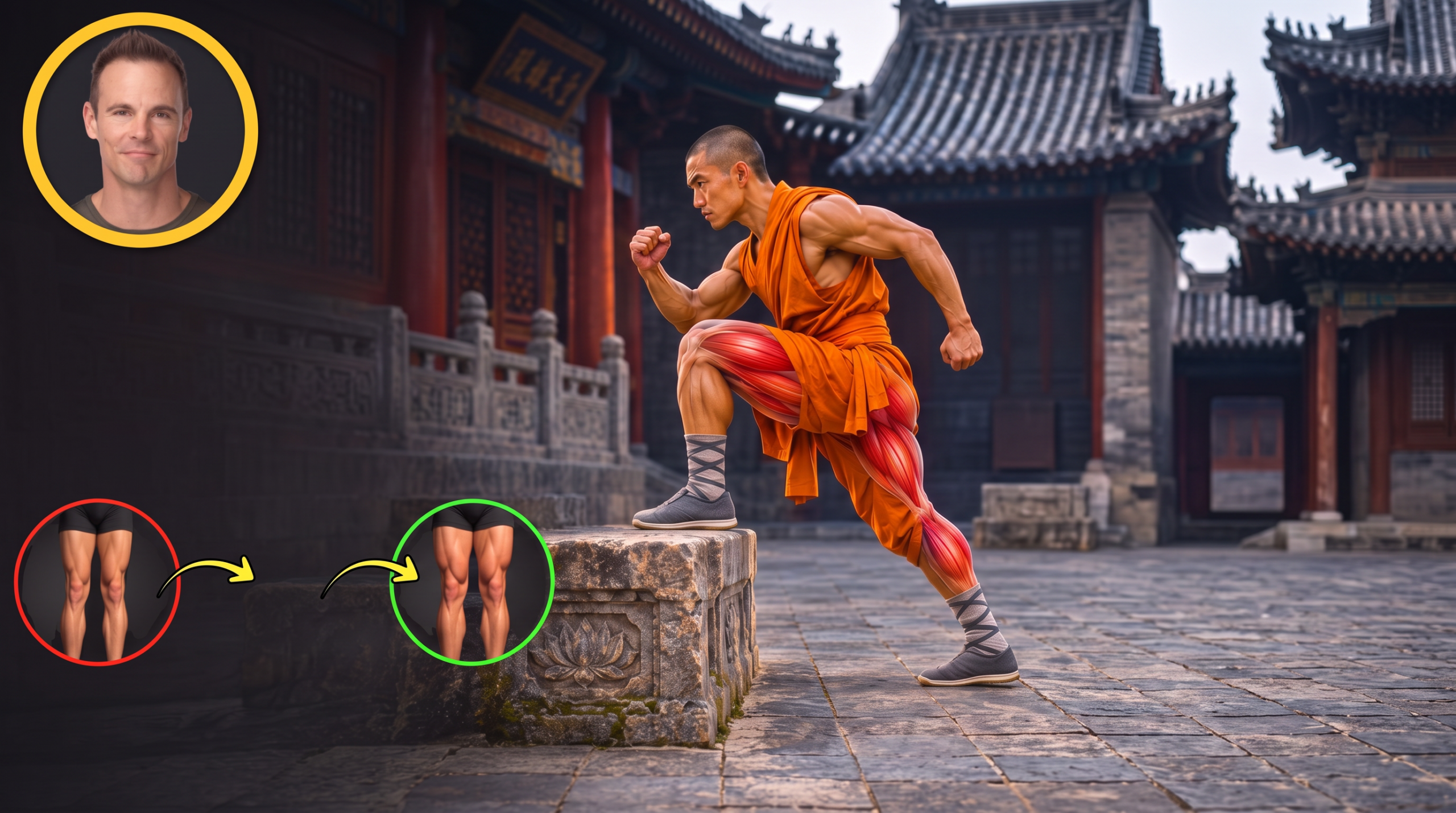
The physical architecture of the historic Shaolin Temple, nestled high in the mountains with its seemingly endless stone stairways, means that climbing upward is a permanent part of daily life for its inhabitants. The step-up replicates this fundamental human movement pattern, training the body to push upward against gravity using one leg at a time.
During bilateral movements like standard squats, the dominant leg can easily compensate for a weaker side, masking muscular imbalances. Single-leg step-ups quickly reveal these discrepancies, leaving many practitioners surprised to discover that one leg is noticeably weaker and less stable than the other. The creator places special emphasis on a slow, controlled lowering phase lasting two to three seconds. While precise claims regarding the exact percentage of muscle growth driven exclusively by the eccentric phase are often debated, sports scientists widely agree that slow, controlled lowering is a highly effective stimulus for muscular development.
6. Single-Leg Balance: The Golden Rooster
The final primary movement, known in traditional kung fu as the Golden Rooster stance, focuses purely on single-leg balance. While holding a static balance on one leg for an extended period sounds trivial, attempting it for a full minute quickly humbles most practitioners. The creator references broader clinical research linking an older adult’s inability to stand unassisted on one leg for just 10 seconds to a higher all-cause mortality risk.
Geriatric and kinesiological experts clarify that this inability is a powerful clinical marker of overall neurological and musculoskeletal health rather than a direct cause of mortality. Nevertheless, balance relies on a sophisticated neuromuscular network involving the ankles, gluteus medius, core stabilizers, and proprioception—all of which can be actively trained and improved at any age. Practitioners quickly realize they are performing the movement correctly when they feel the intricate network of muscles in their foot and ankle making constant, micro-adjustments to keep the body upright.
Bonus Movements: The Resting Squat and Calf Raises
To complement the core six exercises, the creator includes two foundational bonus movements designed to address modern mobility deficits. The first is the deep resting squat. In many parts of the world, resting in a deep, fully compressed squat is a normal, everyday posture, whereas many adults in Western societies struggle to reach the position without tipping backward due to ankle and hip stiffness. Used primarily as a mobility drill, the resting squat opens up tight ankles, hips, and lower backs, ultimately making movements like the duck walk and horse stance more accessible over time.
The second bonus movement is the traditional calf raise. Often referred anatomically as the second heart of the body, the calf musculature plays a critical physiological role during every contraction, helping to actively pump venous blood back up toward the heart. Beyond circulation, strong calves are instrumental in executing rapid balance corrections whenever a person stumbles or loses their footing.
Whether fitness enthusiasts decide to completely retire their barbells or simply integrate these movements as supplementary work, these Shaolin-inspired exercises offer a structured way to address common gaps in stability, mobility, and single-leg control. Fitness professionals recommend introducing new movement patterns gradually and consulting with a qualified healthcare provider if persistent joint discomfort arises.