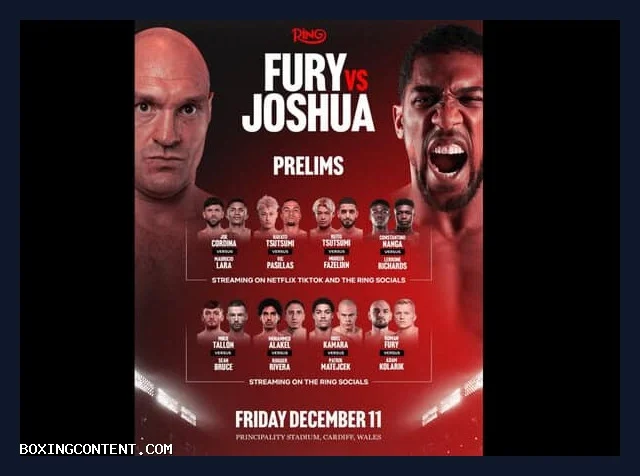
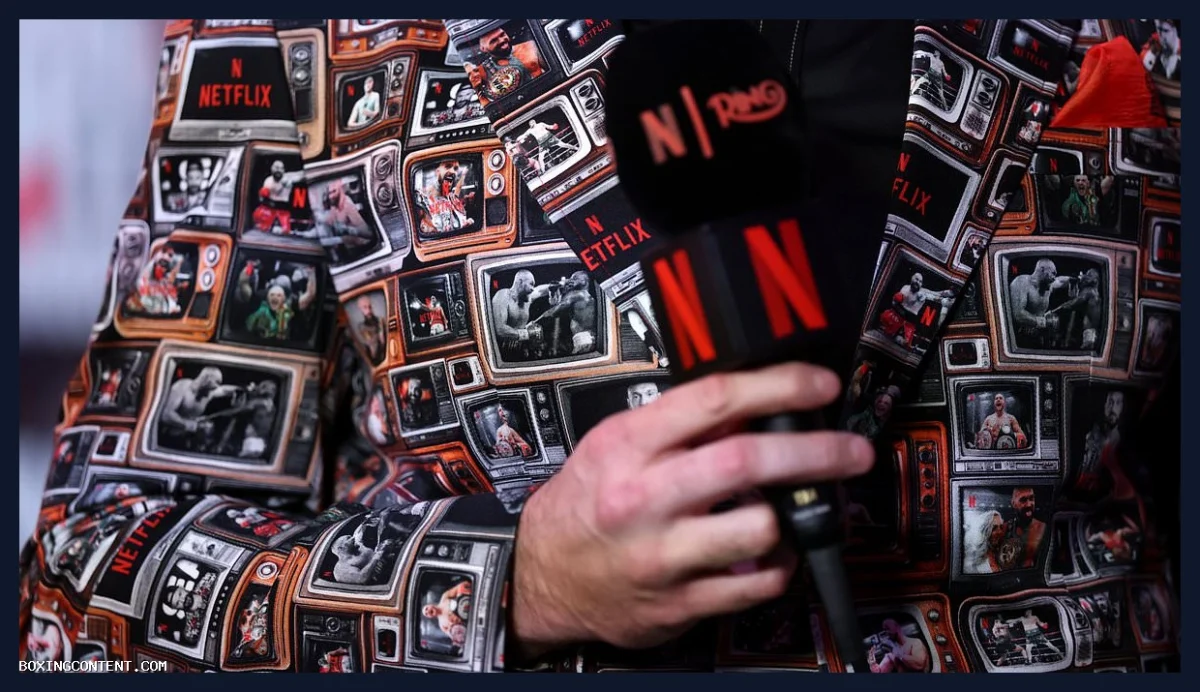
The road to the most anticipated showdown in British boxing history has rarely been a smooth one, but few could have predicted that the biggest threat to the multi-million-pound event would come from inside the broadcasting camp itself. As the combat sports world gears up for Tyson Fury’s blockbuster clash against Anthony Joshua—an encounter projected to draw a massive global audience and a staggering £150 million prize split—Netflix found itself at the center of an extraordinary PR crisis of its own making.
The trouble began when the streaming giant, eager to drum up global interest for its upcoming 90-minute documentary on the heavyweight champion, distributed a promotional teaser to international news organisations. In the footage, Fury’s wife, Paris, made a bombshell revelation regarding the boxer’s historical health struggles.
“He’s a mild schizophrenic and even then the penny didn’t drop,” Paris confessed in the documentary clip. “I thought, ‘Don’t be silly, what’s she on about? Maniacs are schizophrenic.’”
The information was seemingly corroborated by Fury himself during promotional rounds for the film. The heavyweight star recalled seeking help from leading medical professionals following his career-defining 2015 victory over Wladimir Klitschko, stating that he had been diagnosed with both schizophrenia and bipolar disorder.
“I went to a leading specialist and was diagnosed with schizophrenia and bipolar,” Fury said. “I learned that you can never truly get away from mental health. You can only learn to manage and maintain.”
However, these candid revelations, while shedding light on the darker periods of the boxer’s life, inadvertently triggered a regulatory alarm bell that threatened to derail the entire fight card.
Under the strict operational guidelines of the British Boxing Board of Control (BBoC), a licensed fighter is explicitly prohibited from competing if they are found to be suffering from "any psychological disorder such as depression, schizophrenia or hyper-mania."
With an estimated 60 million subscribers expected to tune in, a gate predicted by Dana White to reach £26 million at Cardiff’s Principality Stadium, and a combined £150 million purse on the line, a late cancellation would have been catastrophic. For an £185 billion company trying to establish itself as a heavyweight player in live sports broadcasting, the oversight was widely viewed in industry circles as a monumental unforced error that risked severe reputational damage.
The unfolding crisis caught fire when Daily Mail Sport exclusively reported that the documentary’s disclosures had thrown the December 11 showdown into total chaos. The rest of the British media quickly followed suit, amplifying the story and alerting BBoC General Secretary Robert Smith.
“Tyson will not be allowed to enter the ring unless our doctors are satisfied there is no risk to his health,” Smith firmly warned.
Realizing the immense gravity of the situation, Netflix and the fight promoters scrambled into emergency damage control. Just hours before the global release of the documentary, the streaming platform hurriedly edited the film to excise Paris Fury’s direct reference to her husband suffering from schizophrenia, citing "new information" that had supposedly come to light.
That new information materialized in the form of a hastily issued statement from Paris, who performed a dramatic U-turn on her previous remarks.
“I recalled a conversation from many years ago when discussing Tyson’s condition and I used the word ‘schizophrenic,’” Paris stated. “Whilst Tyson did show some symptoms associated with schizophrenia, he doesn’t have this condition and has never received a diagnosis. Mental health is complex, and it isn’t always easy to find the right words, especially when you’re living it with someone you love.”
The glaring contradiction between Paris’s walk-back and Tyson Fury’s own public statements regarding his medical diagnosis created an awkward public relations dilemma. Prompted by the swirling controversy, the BBoC immediately accelerated its medical assessments, conducting a thorough examination of the fighter late on Thursday evening.
By Friday morning, Robert Smith was able to confirm that the crisis had been averted, announcing that the board’s medical experts were fully satisfied with the fighter’s condition. “All up to date medicals satisfactory and the promoters informed,” Smith stated, clearing the path for the bout to proceed as planned.
The incident brought renewed focus to Fury’s well-documented historical struggles. Following his 2015 triumph over Klitschko, the champion spiraled into a severe mental health crisis marked by debilitating hallucinations and substance abuse.
“For that whole period I was screaming out for help, but everyone around me wanted to put me in a rematch,” Fury recounted of his darkest days. “It was like I was a demon possessed and I needed a hospital rather than a ring. I was hearing voices—horrible, scary voices. At night my head was full of terrifying screams, to the extent I thought someone was in the room. Alcohol and drugs played a part, and I was also comfort eating—mainly sugar.”
While Fury successfully rebuilt his life and career to reclaim his status at the pinnacle of the sport, Netflix’s near-disastrous handling of his documentary highlighted a broader disconnect between the streaming titan’s financial muscle and its institutional sports expertise. Despite committing roughly 5 percent of its £15 billion annual content budget to sports programming, questions have been raised about the production team’s familiarity with boxing history. Notably, when documentary director Lucy Wilcox was asked why the project omitted Fury’s high-profile defeats to Oleksandr Usyk, she admitted she had never heard of the Ukrainian boxing legend.
Logistical friction has also characterized the build-up to the event. Originally envisioned for New York’s iconic Madison Square Garden, the bout was ultimately secured for Cardiff’s 80,000-capacity Principality Stadium following advocacy from local promoters. However, to accommodate the lucrative North American market, Netflix successfully pushed for an unconventional schedule, resulting in an agreed ring-walk time of 1 a.m. local time, with the main event expected to conclude in the early hours of the morning. The unusual timetable required special licensing dispensations from the Cardiff Council, drawing criticism from traditional local fans concerned about late-night disruption in the city.
Compounding these production hurdles are ongoing political tensions behind the scenes. Promoter Eddie Hearn has found himself locked in a persistent public feud with UFC president Dana White over promotional control and billing rights, with Saudi adviser Turki Alalshikh stepping in to broker a fragile peace. White remains adamant that his Zuffa Boxing entity will play a role in the event’s production and has confirmed his attendance in Cardiff, setting up a complex dynamic that Netflix will need to navigate carefully.
As the broadcasting giant prepares for another major live sporting event following previous technical setbacks during the Jake Paul and Mike Tyson spectacle, the pressure is firmly on. With millions of viewers watching and the regulatory storm safely weathered, Netflix must now prove it can deliver a seamless, high-stakes sporting broadcast without stumbling in the final rounds.