

In an era where social media feeds are constantly flooded with new, unconventional workout trends promising dramatic physical transformations, one popular fitness creator decided to separate science-backed utility from internet hype. Armed with a straightforward evaluation metric—asking simply whether a movement will actually grow the glutes—she put more than a dozen trending exercises through rigorous real-world testing.
In a recent comprehensive video breakdown, she sorted over a dozen viral lower-body movements into keepers, toss-bin candidates, and experimental works-in-progress. While the digital fitness landscape often rewards novelty and complex setups over biomechanical efficiency, her experiment revealed that several heavily hyped favorites ultimately failed to deliver. In one notable instance, her practical testing even led her to politely disagree with renowned fitness expert Jeff Nippard regarding the efficacy of a trending movement.
For gym-goers looking to optimize their next lower-body training block without wasting time on suboptimal trends, understanding which exercises earned a permanent spot in her routine—and which were discarded—offers a valuable roadmap for effective glute development.
The Exercises She Is Keeping
Among the crowded field of viral contenders, a select few movements earned high praise for their stability, loading capacity, and ability to target the target muscle groups effectively.
Leading the keep pile is the Dead Stop Smith Machine Single-Leg Romanian Deadlift. The viral pitch behind this variation suggests that the dead stop forces the glute max to do one hundred percent of the work during the concentric phase of the lift. While her take on the movement offered a bit more nuance, her endorsement remained glowing. She noted that utilizing the Smith machine effectively removes grip fatigue from the equation while delivering serious stability for a challenging single-leg lift, leading her to state that she is one hundred percent keeping the variation in her program. However, she offered an important caveat: because the lift can be heavily loaded, secondary stabilizers such as the lats, quadratus lumborum, and erector spinae experience significant fatigue as well. She emphasized that no single exercise isolates a muscle completely, advising adequate rest between legs. As a practical pro tip for lifters attempting the movement, she recommended grabbing a plate to rest the weight on, noting that the built-in safety stops on most Smith machines sit too high to allow for a full, uninhibited range of motion.
Another major winner was the V-Squat Machine Step-Up. While gym equipment setups can vary widely from facility to facility, the underlying mechanical payoff remains consistent. By utilizing the machine instead of holding traditional free weights, lifters eliminate hand fatigue and momentum, creating a pure lower-body focus. Standard step-ups often tempt individuals to drop momentum at the bottom of the movement or inadvertently push off the trailing foot to complete the repetition. On the V-Squat machine, however, slow, controlled repetitions and a significantly longer range of motion come naturally.
The KAS Glute Bridge also secured a lasting spot, having successfully transitioned from a passing social media trend to a permanent fixture in modern physique training. Despite its distinct nomenclature, she noted that the movement functions as a close relative of the traditional barbell hip thrust. Lifters maintain position near the top of the movement and lower the weight by only a few inches, ensuring that the bar never completely rests on the floor. This technique maintains constant tension on the glutes during the phase of the lift where the muscles are most shortened.
Weighted glute medius kickbacks also made the cut, though she addressed the ongoing, heated debates surrounding kickback variations. While internet claims frequently suggest that minor variations in cable angles can isolate exclusively the glute medius or specific sections of the lower glutes, she pointed out that many of these hyper-specific isolation claims remain unproven. Her practical advice for lifters is to select one kickback variation that they can genuinely feel working and avoid stacking four different variations into a single weekly routine. The specific version she endorsed keeps the body in the frontal plane, utilizing a held plate for an enhanced stretch before finishing with a powerful squeeze at end-range.
Rounding out the keep pile is the Smith Machine Reverse Frog Pump. While acknowledging that the setup looks inherently awkward—noting that she filmed the movement in an empty gym and would hesitate to attempt it around other gym-goers—the mechanical results spoke for themselves. For individuals who primarily feel traditional reverse hypers in their lower backs, this variation serves as a useful alternative. By setting the gym safety pins low, resting the head flat on a bench, and keeping the neck relaxed, she found that the movement allowed her glutes to feel fully shortened while retaining additional range of motion to push through under continuous muscular activation.
Worth Practicing: Rotational Cable Step Down
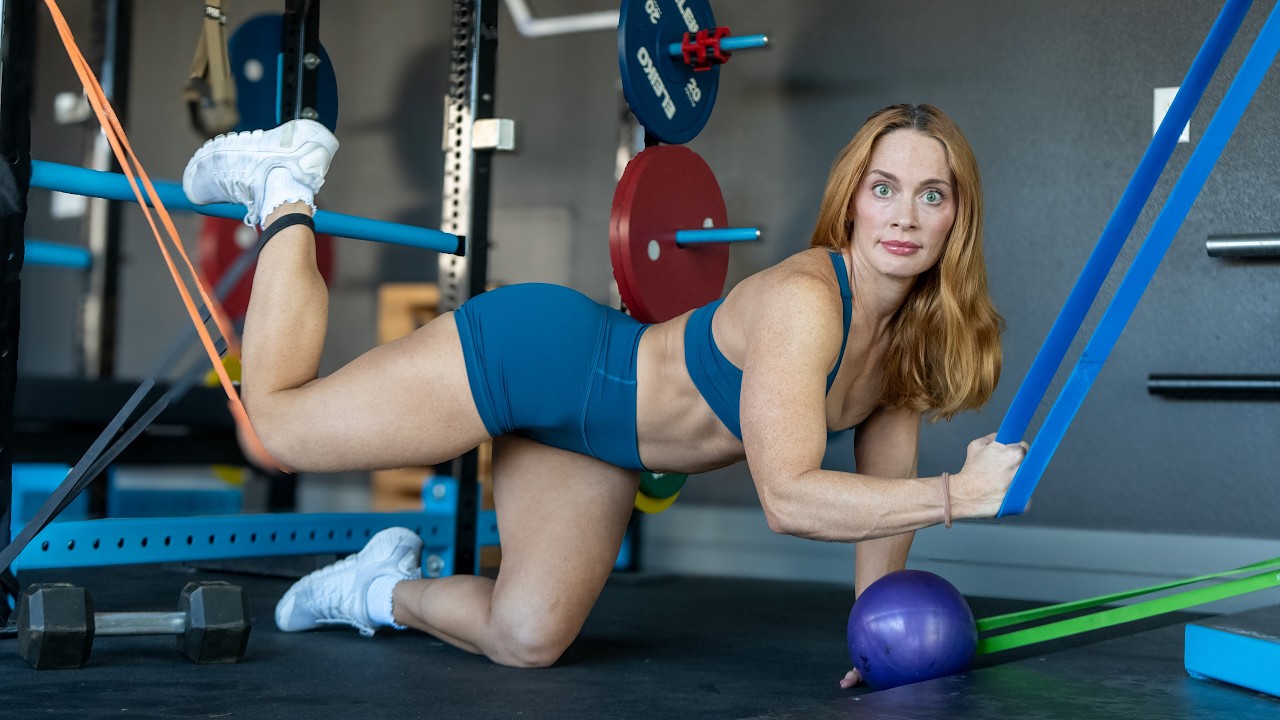
Among the movements that required deeper evaluation rather than an immediate dismissal was the Rotational Cable Step Down. The viral premise behind the exercise is that it removes quad dominance from the traditional step-up while introducing a rotational component that most standard lower-body movements lack.
Her verdict ultimately landed as a conditional yes. While she decided to keep the movement in her experimental rotation, she emphasized that it requires a significant amount of practice to master. The initial equipment setup is notoriously tricky, and the coaching cues are far from intuitive for the average gym-goer. Furthermore, improper form can easily allow unwanted rotation to creep into the lower back. She indicated plans to update her audience after dedicating more time to testing the movement’s long-term utility.
The Toss Pile
Not every viral trend survived her rigorous evaluation. Several movements that have accumulated millions of views across social media were promptly relegated to the trash bin due to poor biomechanics or inefficient loading potential.
Ballerina Bulgarians serve as a prime example. Social media creators frequently promised that elevating the heel and shifting foot posture during Bulgarian split squats would target the upper-glute shelf ten times more effectively than standard variations. Her practical experience, however, proved the exact opposite. She noted that the modification significantly shrinks the functional range of motion while inadvertently forcing the quadriceps to take over the movement. Traditional Bulgarian split squats remain superior because they allow lifters to load significantly heavier while effectively isolating a single leg.
Another surprising casualty in the toss pile was the Seated Cable Deadlift. The movement had recently been endorsed by prominent fitness educator Jeff Nippard based on theoretical advantages such as an extended range of motion, enhanced stability provided by foot pads, and reduced spinal stress compared to traditional free-weight deadlifts. Despite the logical reasoning on paper, her real-world testing led her to a different conclusion. She found that grip strength quickly became the primary limiting factor, while reaching forward to grab the cable attachment shifted the muscular burn away from the posterior chain and straight into her lats. While she acknowledged that the specific design of her gym’s cable machine might have influenced her results, she ultimately chose to discard the movement in favor of traditional standing deadlifts, which allow lifters to engage their lats and pull substantially heavier loads.
Burners Versus Builders
Several other trending exercises were categorized not as outright failures, but rather as inefficient tools that fail to justify their place over foundational compound movements.
The Sumo Squat into Romanian Deadlift combination, touted in viral clips as a miracle routine capable of doubling a person’s glute size, received a lukewarm reception. While she acknowledged feeling a noticeable glute burn—largely driven by the external rotation and shortened knee positioning inherent in the sumo stance—she pointed out a fundamental mechanical flaw. The deadlift portion of the hybrid movement is artificially capped by the relatively lighter weight one can safely manage in a sumo squat position. Concluding that the combination functions well as a fun finisher rather than a primary mass builder, she advised that lifters will always achieve a better return on investment by prioritizing heavy, dedicated squats and deadlifts.
Similarly, the Assisted Pull-Up Machine Step Down sparked a debate regarding equipment versatility. While some critics argue that specialized gym machinery should strictly remain confined to its intended upper-body purpose, she defended the use of versatile equipment if it serves a practical training need. The primary drawback she discovered, however, was the limitation of the machine’s weight stack. Even during her warm-up sets, she found herself utilizing a massive portion of the available weight stack, and subsequent repetitions failed to deliver the targeted glute engagement at the dead stop. She noted that while beginners seeking convenience might find the machine useful if they can effectively load it, stronger lifters are far better off utilizing traditional step-ups or single-leg leg press variations.
Reflecting on the broader implications of her experiment, her overarching takeaway for fitness enthusiasts is simple: viral popularity online does not equate to physiological effectiveness in the gym. Ultimately, lifters should evaluate every movement based on its capacity for heavy loading, structural stability, and whether the targeted muscle is genuinely engaged throughout the exercise.