


The legendary clashes between Jack Dempsey and Gene Tunney stand enduringly among boxing’s most storied championship bouts, serving as monumental sports spectacles that captivated America and the world during the turbulent, glittering era of the 1920s. This week marks the one hundredth anniversary of their first historic encounter, a milestone that invites a deep reflection on the lives, careers, and cultural impact of two men who defined an entire generation of athletic competition.
Jack Dempsey bridged boxing’s rugged, unregulated old era and its modern, commercialized incarnation, cementing his status as one of the most charismatic and ferocious fighters in sports history. Growing up in grinding poverty, Dempsey’s early life was defined by transient hardship. Biographer Randy Roberts recounts that the young Dempsey lived in mining camps and hobo jungles, rode the railway rods, and more than once begged for food. Yet what separated him from others in his desperate circumstances was an unyielding willingness, and even eagerness, to work. He accepted any employment available, from washing dishes, cutting lawns, and scrubbing floors to the much harder physical labor of coal-mining, digging ditches, and picking fruit.
Reflecting on his origins later in life, Dempsey offered a characteristic defense of his dignity: "I was a hobo. But I was never a bum."
Fighting under the moniker "Kid Blackie," Dempsey amassed roughly 100 fights across Colorado, Utah, and Nevada from 1911—when he turned just 16—through 1914. Survival in the ring was often a matter of immediate economic necessity. He later recalled that when you are fighting, you are fighting for one primary thing: to get money. As a young man, he was knocked down plenty and often wanted to stay down, but necessity forced him up to collect the $2 prize for winning or face starvation. He remembered a bout where he was knocked down 11 times before getting up to win, driven by the desperation of a hungry fighter who had not eaten in two days.

In the ring, Dempsey attacked with unrelenting ferocity. Legendary trainer Ray Arcel likened him to a saloon fighter, observing that with Dempsey, every part of the human body was treated as a legal target. Sportswriter Paul Gallico echoed that assessment, writing that Dempsey seemed to possess a constant, bottomless well of cold fury near his throat. He had tremendous courage, speed, determination, and exceptional punching power. While he was never considered a polished defensive boxer, his ultimate protection was sheer aggression. When the opening bell rang, Dempsey ran out to attack his opponent, maintaining a relentless assault until the bell ended the round, wearing a smoldering truculence on his face and absolute determination in his eyes. Dempsey himself summarized his philosophy simply: to be a good fighter, you must be able to give punishment, take it, and possess an unbreakable fighting heart.
As America approached the "Roaring Twenties," boxing was languishing at a low tide. The sport had lacked a truly popular heavyweight champion since James Jeffries retired in 1904, and moral reformers were actively attacking the sport as sinful, gaining significant momentum after Jack Johnson claimed the championship in 1908. On 5 April 1915, Jess Willard defeated Johnson in Havana, emerging as a champion poised for potential stardom. However, Willard subsequently went on tour with theatrical companies like Buffalo Bill’s Wild West Show, defending his title only once across four years.
Finally, in 1919, premier boxing promoter Tex Rickard lured Willard back to the ring with a $100,000 guarantee to face Dempsey in Toledo, Ohio, on 4 July. It marked the first major outdoor prizefight in the United States since Jeffries had returned from retirement to face Johnson in 1910. The physical disparity was striking: Willard weighed 245 pounds, while Dempsey tipped the scales at just 187. After three brutal rounds, Willard’s jaw and nose were broken, six teeth had been knocked out, and he suffered severe cuts around his eyes, forcing him to quit. Jack Dempsey was the new heavyweight champion of the world.
Rickard envisioned transforming boxing into a respectable, mass-appeal sport for all social classes, and Dempsey’s electrifying style and raw charisma made him the ideal instrument. As religious reform movements weakened and more states legalized the sport, subsequent bouts like Dempsey versus Georges Carpentier elevated the sweet science to unprecedented cultural heights.
The Dempsey-Carpentier showdown took place on 2 July 1921 in a temporary arena at Boyle’s Thirty Acres near Jersey City. More than 80,000 spectators—the largest crowd to witness an American sporting event up to that time—attended, generating a live gate of $1,789,238, more than double the previous record and equivalent to over $32.5 million today. Furthermore, it was the first world championship bout broadcast live on radio with a blow-by-blow description.
Carpentier was hailed globally as a man of destiny. As the reigning world light-heavyweight champion, his image was burnished by his service as a decorated military pilot during the First World War. Handsome, graceful, intelligent, and debonair, he was regarded by many as the most glamorous figure ever to step into a ring. In contrast, Dempsey was viewed as his dark shadow, having faced trial and eventual acquittal for draft evasion during the war. With his coarse beard, thick eyebrows, and permanent scowl, Dempsey’s natural shyness was misconstrued by the public as meanness and conceit. As Roberts noted, the bout was cast as a classic hero versus villain narrative, with the foreign challenger cast in the preferred heroic role. Dempsey himself later acknowledged the dynamic, recalling that the Frenchman was the universally adored hero while he was viewed as the flat-nosed outsider.
The "Fight of the Century" commanded global attention. On the morning of the match, sportswriter Grantland Rice declared it the single greatest day in the ancient history of the sport, capturing the imagination of crowds worldwide. Elite figures including Vanderbilts, Rockefellers, Whitneys, and Astors filled ringside seats, while the United States Senate and House of Representatives adjourned early so that 12 senators and 90 congressmen could attend. Women attended in large numbers, mingling freely with male spectators for the first time.
When ring announcer Joe Humphreys introduced the fighters, the crowd’s response underscored the social divide. While Dempsey received only a polite murmur and light applause, the introduction of Carpentier elicited a deafening roar from the 80,000 fans. The bout itself, however, proved to be one of the most lopsided mismatches in heavyweight history, concluding swiftly when Dempsey knocked Carpentier out. Despite his decisive victory, Dempsey read the next day’s newspapers with lingering bitterness, realizing that the public had embraced his opponent while viewing him merely as a brutal victor.
Dempsey’s legend expanded further on 14 September 1923, when he faced Argentina’s "Wild Bull of the Pampas," Luis Firpo, before more than 88,000 fans at the Polo Grounds in New York, with tens of thousands more turned away. Ten seconds into the opening round, Firpo dropped Dempsey to his knees. The champion rose only to floor Firpo seven times before Firpo launched a ferocious right hand that famously knocked Dempsey completely out of the ring into the press section. Cut on his lower back by a typewriter, Dempsey was pushed back into the ring by writers before the count of ten. In the second round, Dempsey recovered to knock Firpo down twice more, securing a knockout victory at 57 seconds.
True to form, Dempsey placed his title on ice following the Firpo bout, remaining inactive for three years before returning on 23 September 1926 to face Gene Tunney.
Tunney was a brilliant, meticulous tactician whose only defeat in 67 professional bouts had come against Harry Greb. A voracious reader dedicated to self-improvement, Tunney faced persistent ridicule from portions of the press who dismissed his intellectual pursuits as a gimmick. Critics argued that a fighter stepping into the ring against Dempsey needed a natural, vicious killer instinct rather than an appreciation for first editions and works of art. Tunney defended his habits, questioning why a love of reading should be treated as a joke when education was something society should champion.
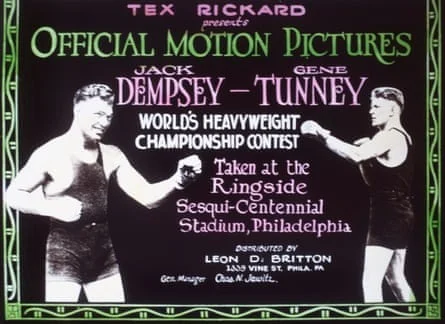
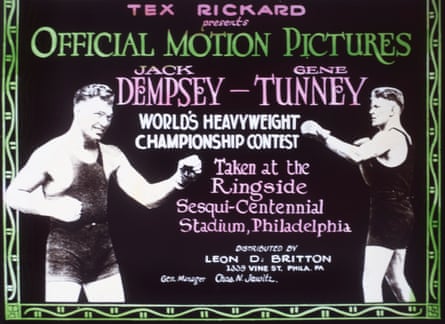
A staggering crowd of 120,757 fans jammed Philadelphia’s Sesquicentennial Stadium to witness the challenge, generating record gate receipts of $1,895,733—over $36 million today—while an estimated 39 million people listened via radio. Scheduled for 10 rounds, the fight pitted a 29-year-old challenger in his prime against a weathered champion who had been out of the ring for three years.
From the opening bell, Dempsey realized his reflexes were compromised. Tunney glided across the canvas, repeatedly tagging the former champion with a sharp left jab and accumulating points while avoiding major damage. Tunney won every round decisively, cutting Dempsey over the right eye and effectively shutting his left eye by the conclusion of the bout. Accepting the defeat with grace, Dempsey offered no alibis, admitting he had lost to a superior man. Yet as he walked out of the ring, something unexpected happened: for the first time in his career, the partisan crowds did not boo him. Instead, they cheered loudly, calling out his name in a moment of public validation he had long hungered for.
One year later, Dempsey and Tunney met in a historic rematch before 104,843 fans at Chicago’s Soldier Field, generating boxing’s first $2 million gate. That encounter, also won by Tunney via decision, remains etched in sports history for the infamous "long count" controversy in the seventh round—a dramatic chapter that would soon follow in the annals of the sport.