
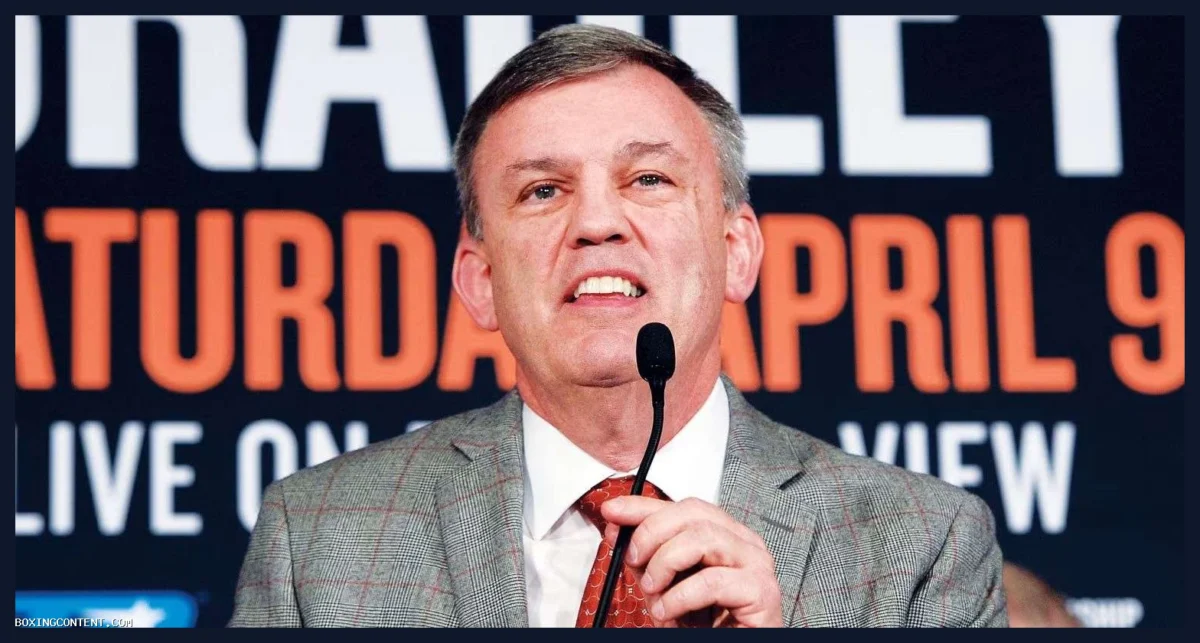
Throughout a legendary career spanning decades inside and outside the squared circle, fan-favourite boxing trainer, commentator, and fight analyst Teddy Atlas has cornered some of the finest talents the sport has ever seen. Having worked with a total of 18 world champions over the course of his illustrious journey in boxing, Atlas’s resume reads like a who’s who of pugilistic excellence. Yet, despite guiding numerous elite competitors to the pinnacle of the sport, there is only one fighter who truly sticks out in his memory as his absolute favourite to coach.
The Staten Island-born coach first cut his teeth in the legendary atmosphere of Cus D’Amato’s Catskill gym, serving as an assistant to the mastermind who famously shaped the career of a young Mike Tyson. Following his formative years under D’Amato’s demanding tutelage, Atlas stepped out on his own to establish a formidable reputation as a head trainer. Over the ensuing years, his tactical acumen and fierce motivational style guided the likes of Tim Bradley, Donny Lalonde, Alexander Povetkin, Oleksandr Gvozdyk, and Michael Grant through grueling world championship campaigns and high-stakes prizefights.
However, despite the immense talent and accomplishments of those stellar names, Atlas’s most iconic and historic success came alongside another fierce competitor from New York: Michael Moorer. Together, Atlas and Moorer scaled the highest mountain in the sport in 1994 when Moorer challenged and dethroned the legendary Evander Holyfield. That thrilling victory captured the unified WBA and IBF heavyweight world titles and etched Moorer’s name into the history books as boxing’s very first southpaw heavyweight world champion, marking a monumental triumph for the fighter-trainer partnership.
Reflecting on those glory years and his vast body of work in a recent appearance, Atlas opened up about his unique bond with Moorer. Speaking in an in-depth conversation with Ring Champs with Ak & Barak, in collaboration with All The Smoke Fight, the veteran analyst admitted that Moorer was the fighter whom he most enjoyed training. According to Atlas, this preference did not stem merely from the historic hardware they collected, but rather from the complex psychological landscape of the fighter and his initial lack of self-belief.
Delving into the intricate dynamics of their relationship, Atlas explained that the emotional connection he shared with Moorer made the journey deeply personal and fulfilling. He noted that Moorer possessed a vulnerability that required constant reassurance, a trait deeply intertwined with the fighter’s personal history outside the ring.
“Yeah, [it was Michael Moorer] because he needed what I needed,” Atlas shared during the interview, offering a candid glimpse into the emotional symmetry of their coach-athlete bond.
“There was a part to Michael that you always had to be aware of, to reinforce him. He would start to lose faith in himself and it is all connected to something.”
Atlas went on to elaborate on the human element behind Moorer’s outward toughness as a world-class heavyweight, pointing to early life hardships that shaped the champion’s inner psychology. By understanding the roots of Moorer’s occasional self-doubt, Atlas was able to provide the exact type of structural and emotional support the fighter required to perform at his absolute best under the bright lights of world championship boxing.
“He had a good heart and I also knew that his father left him when he was young. He needed someone there, he was a genius,” Atlas reflected, highlighting the profound intellect and emotional depth that underpinned Moorer’s exceptional athletic gifts.
The partnership between Atlas and Moorer produced some of the most dramatic chapters of 1990s heavyweight boxing, though their journey was far from a straightforward upward trajectory. Shortly after their historic victory over Holyfield, Moorer faced the legendary George Foreman in his first defense of the unified heavyweight crown. In a stunning and iconic moment that reverberated throughout sports history, Moorer lost the unified heavyweight marbles when a forty-five-year-old Foreman famously turned back the clock to score a dramatic knockout, a bout that remains one of the most celebrated upsets in boxing lore.
Despite that devastating setback, the bond and resilience forged between Moorer and Atlas allowed the fighter to bounce back at the elite level. Proving his championship mettle and the effectiveness of his foundation, Moorer successfully rebuilt his career over the subsequent years. Two years after losing the belts to Foreman, Moorer recaptured a share of the heavyweight throne by securing the IBF world title through a hard-fought split-decision victory over Axel Schulz.
That second reign as champion further cemented Moorer’s status as one of the premier heavyweights of his era, before his career eventually crossed paths with Holyfield once more. Moorer ultimately lost the title the following year in a highly anticipated rematch against Holyfield, closing a definitive chapter on a rivalry that defined an unforgettable era of the heavyweight division. Today, while Atlas continues to lend his sharp analytical mind to boxing broadcasts and commentary booths around the world, his reflections on Michael Moorer serve as a powerful reminder of the deep, psychological bonds that unite great trainers and the champions they forge.