

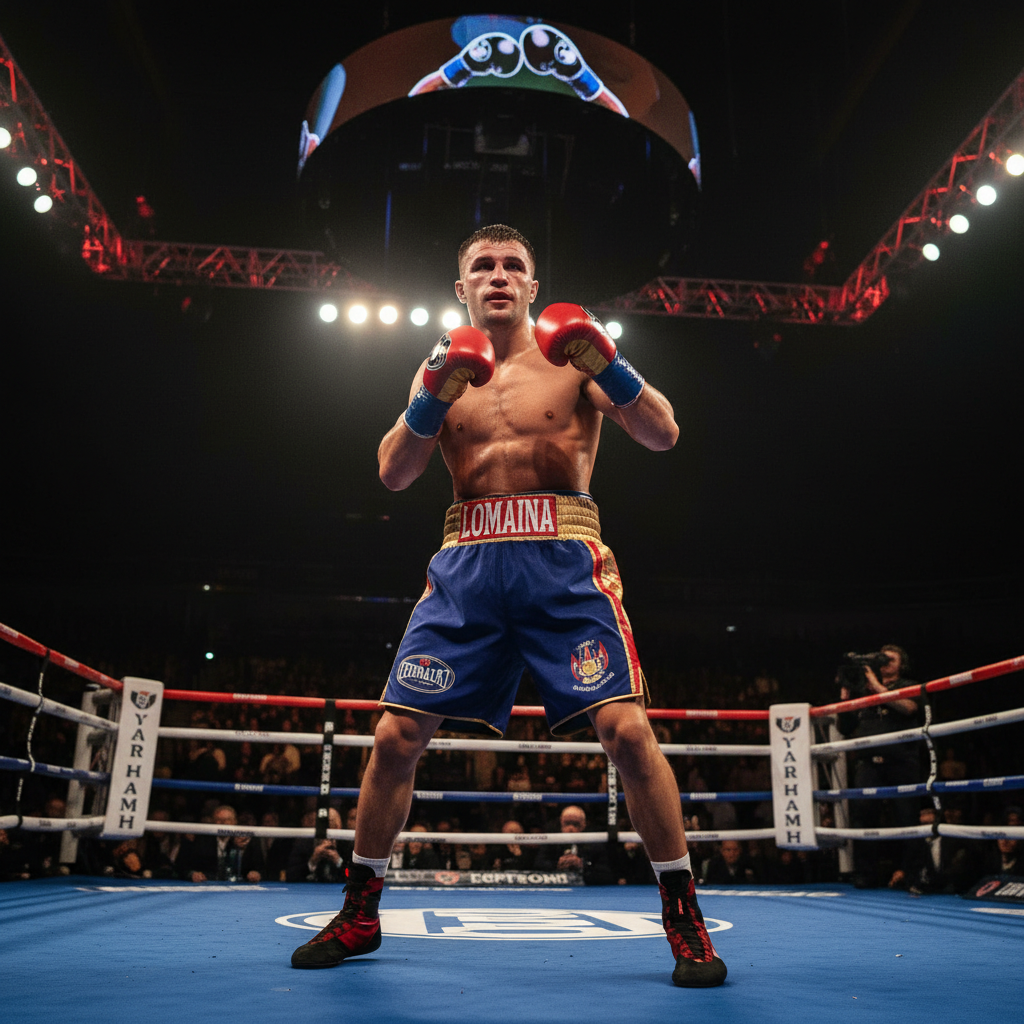
In the annals of boxing history, few names command as much respect for technical mastery as Vasyl Lomachenko. Known globally by his monikers ‘The Matrix’ and ‘High-Tech’, Lomachenko revolutionized modern boxing with his unparalleled footwork, defensive angles, and precision punching. His journey from a small town in Ukraine to the bright lights of Las Vegas represents a relentless pursuit of perfection, guided by a unique training philosophy that transcends the traditional boundaries of the sport.
Early Life and the Influence of ‘Papachenko’
Vasyl Anatolyevich Lomachenko was born on February 17, 1988, in Bilhorod-Dnistrovskyi, in the Ukrainian SSR of the Soviet Union. Boxing was in his blood from the very beginning. His father, Anatoly Lomachenko, was a boxing coach, and his mother was a gymnastics instructor. This combination of athletic disciplines would later define Vasyl’s unique style. Anatoly, affectionately known as ‘Papachenko’ by boxing fans, did not rush his son into the ring. Instead, he cultivated a holistic athlete.
One of the most fascinating aspects of Lomachenko’s early development was his father’s insistence that he attend traditional Ukrainian dance classes before focusing solely on boxing. For several years during his youth, Vasyl trained in dance, a practice that initially frustrated him but ultimately endowed him with the rhythmic footwork and balance that would become his trademark. This unorthodox foundation allowed him to move around opponents with a fluidity that few could replicate.
The Greatest Amateur Career in History
Before turning professional, Vasyl Lomachenko compiled what is widely regarded as the most impressive amateur record in the history of the sport. He finished his amateur career with an astonishing record of 396 wins and only 1 loss—a defeat he avenged twice. His dominance was not just about winning; it was about the manner in which he dismantled opponents, often outclassing them to the point of helplessness.
Lomachenko’s amateur accolades are the stuff of legend. He won the Gold Medal at the 2008 Beijing Olympics as a featherweight, receiving the Val Barker Trophy as the outstanding boxer of the tournament. Four years later, he moved up in weight and captured a second Gold Medal at the 2012 London Olympics as a lightweight. In addition to his Olympic triumphs, he secured two World Championship gold medals in 2009 and 2011, cementing his status as a generational talent before ever fighting for a paycheck.
Turning Professional: The Fast Track
In 2013, Lomachenko turned professional under the Top Rank banner, but he had a specific demand: he wanted to fight for a world title immediately. While he didn’t get a title shot in his debut, he fought a seasoned veteran in his first bout and then challenged Orlando Salido for the WBO Featherweight title in only his second professional fight. Although he lost a controversial split decision to a heavier, rough-house Salido, the experience proved to be a vital learning curve for the Ukrainian prodigy.
Undeterred by the setback, Lomachenko made history in his very next fight. In June 2014, in just his third professional bout, he dominated Gary Russell Jr. to win the WBO Featherweight title. This victory tied the record for winning a world title in the fewest number of fights, a record held by Saensak Muangsurin. It was a clear statement that ‘High-Tech’ had arrived and was operating on a different level than his peers.
Conquering the Super Featherweight Division
After defending his featherweight title multiple times, Lomachenko moved up to the Super Featherweight division (130 lbs). His debut in this weight class was a spectacular knockout of Roman ‘Rocky’ Martinez in 2016 to capture the WBO Junior Lightweight title. This victory made him a two-weight world champion in just seven fights, shattering another boxing record for the fastest ascent to a second division title.
It was during his reign at Super Featherweight that Lomachenko earned a reputation for making opponents quit on their stools, leading fans to jokingly call him ‘No-Mas-Chenko’. In 2016, he faced the dangerous puncher Nicholas Walters. Lomachenko’s movement and precision were so overwhelming that Walters, a fierce competitor, refused to continue after the seventh round. This psychological dominance became a recurring theme in his fights during this era.
Perhaps the most anticipated bout at this weight was against fellow two-time Olympic Gold Medalist Guillermo Rigondeaux in 2017. Billed as a historic clash of masters, the fight turned into a showcase for Lomachenko. He utilized his size, speed, and angles to completely neutralize the Cuban defensive wizard. Rigondeaux, frustrated and unable to land any significant offense, quit on his stool after the sixth round, further elevating Lomachenko’s pound-for-pound status.
Lightweight Supremacy and The Linares Test
Seeking greater challenges, Lomachenko moved up to the Lightweight division (135 lbs) to challenge Jorge Linares for the WBA (Super) Lightweight title in 2018. This fight provided one of the rare moments of vulnerability in Lomachenko’s career when he was knocked down in the sixth round. However, displaying the heart of a champion, he rose from the canvas and stopped Linares with a perfectly placed liver shot in the tenth round to become a three-weight world champion in just 12 fights.
He continued to unify the division, adding the WBO title by defeating Jose Pedraza and the vacant WBC title by outpointing Luke Campbell in London. By 2019, Lomachenko held three of the four major belts in the lightweight division, with only the IBF title eluding his grasp. His technical brilliance seemed insurmountable, and he was widely considered the number one pound-for-pound fighter in the world.
Setback and Resilience: The Teofimo Lopez Fight
In October 2020, amidst the global pandemic, Lomachenko faced the young and hungry IBF champion, Teofimo Lopez, in a unification bout. In a surprising turn of events, Lomachenko started too slowly, giving away the early rounds to the larger Lopez. Although he rallied fiercely in the second half of the fight, he lost a unanimous decision. Following the fight, it was revealed that Lomachenko had entered the ring with an injured shoulder that required immediate surgery, adding context to his hesitant start.
War in Ukraine and a Pause in Career
Lomachenko’s career took a dramatic pause in early 2022 following the Russian invasion of Ukraine. Despite having a lucrative fight lined up against George Kambosos Jr. for the undisputed championship, Lomachenko chose to remain in his homeland. He joined the Belgorod-Dnestrovsky Territorial Defense Battalion, patrolling the streets and defending his family and country. This act of patriotism garnered him immense respect worldwide, proving his character extended far beyond the boxing ring.
The Return and Controversy
Lomachenko returned to the ring later in 2022 to defeat Jamaine Ortiz, setting up a clash with the undisputed lightweight champion, Devin Haney, in May 2023. The fight was a tactical chess match, with many observers and experts believing Lomachenko had done enough to win, landing the cleaner, more effective punches in the later rounds. However, the judges awarded a unanimous decision to Haney. The result was highly controversial, with the crowd booing the decision and fans debating the scoring for months afterward.
Regaining Championship Status
Refusing to let the controversy end his career, Lomachenko traveled to Australia in May 2024 to face George Kambosos Jr. for the vacant IBF Lightweight title. Looking rejuvenated and sharp, Lomachenko dominated the former champion, stopping him in the 11th round. This victory was a vindication, proving that even in his mid-30s, the veteran master still possessed the skills to reign as a world champion.
Legacy and Fighting Style
Vasyl Lomachenko’s legacy is defined by his revolutionary fighting style. He creates angles that shouldn’t exist, pivoting around opponents to strike from the side or back while they are still punching at his shadow. His ‘downloading’ process, where he spends the early rounds analyzing his opponent’s rhythm before dismantling them, is a testament to his high boxing IQ. Regardless of future outcomes, Lomachenko has secured his place in the International Boxing Hall of Fame as one of the most gifted technicians to ever lace up a pair of gloves.