
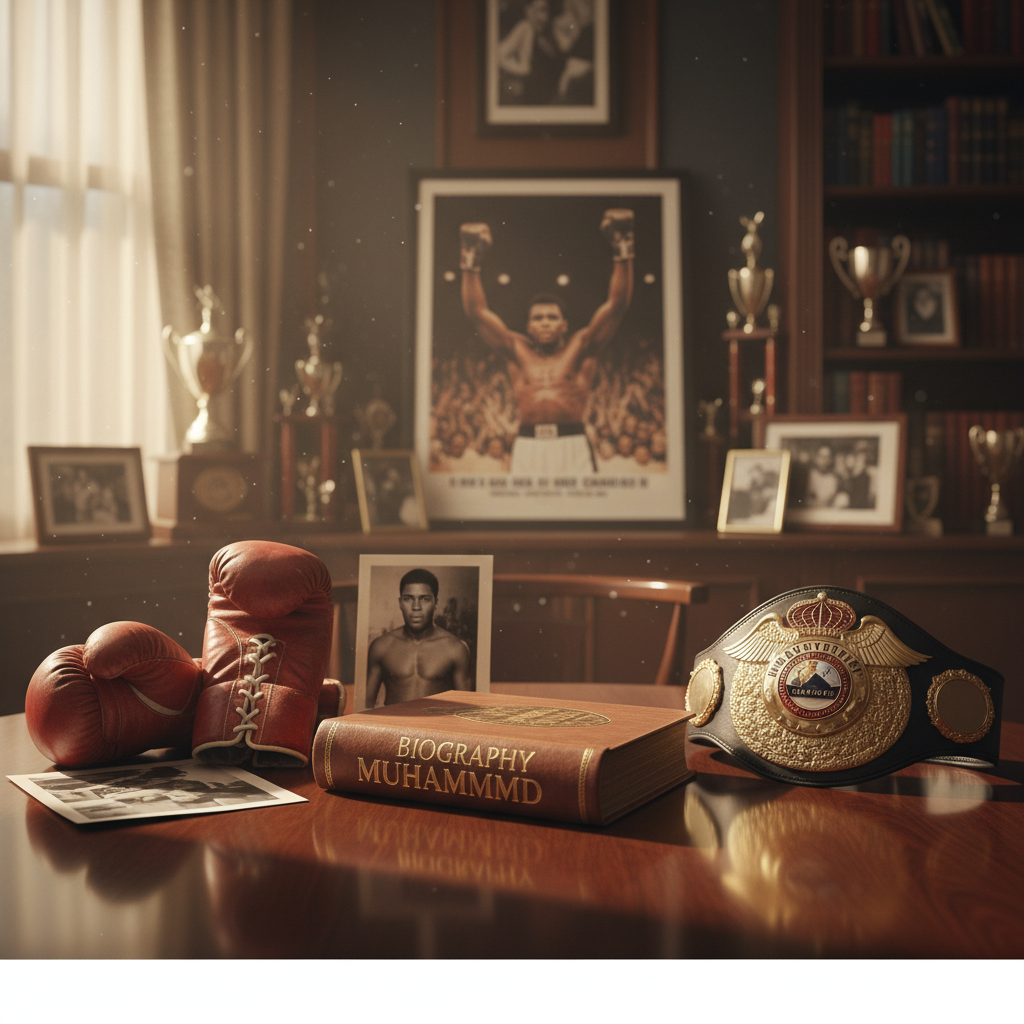
Muhammad Ali remains one of the most significant and celebrated sports figures of the 20th century. Known globally as ‘The Greatest’, Ali was not only a three-time World Heavyweight Champion but also a charismatic poet, a civil rights activist, and a humanitarian who transcended the sport of boxing. His life story is a testament to conviction, resilience, and the power of self-belief, influencing generations far beyond the ring.
Early Life in Louisville
Born Cassius Marcellus Clay Jr. on January 17, 1942, in Louisville, Kentucky, the future champion grew up in the segregated South. His father painted billboards and signs, while his mother worked as a household domestic. The racial discrimination he witnessed during his childhood in Kentucky would later fuel his passion for social justice and activism. Despite the challenges of the era, Clay was known for his lively personality and confidence even as a child.
The catalyst for his boxing career was an incident involving a stolen bicycle. When a 12-year-old Clay reported the theft to a police officer named Joe Martin, he vowed to ‘whup’ the thief. Martin, who ran a local boxing gym, suggested that Clay learn how to fight first. This chance encounter set Clay on a path that would change sports history. He dedicated himself to training, quickly displaying unnatural speed and reflexes for his size.
Amateur Success and Olympic Gold
Cassius Clay’s amateur career was nothing short of spectacular. He won six Kentucky Golden Gloves titles, two national Golden Gloves titles, and an Amateur Athletic Union national title. His amateur run culminated at the 1960 Rome Olympics, where the 18-year-old Clay won the gold medal in the light heavyweight division. He returned to the United States as a hero, yet he was still met with the harsh realities of racial segregation, a paradox that deepened his resolve.
Turning professional shortly after the Olympics, Clay quickly made a name for himself not just with his fists, but with his mouth. He was unlike any heavyweight before him; he danced around the ring with his hands down, boasting a style he described as ‘float like a butterfly, sting like a bee.’ His brash personality and tendency to predict the round in which he would knock out his opponents earned him the nickname ‘The Louisville Lip,’ drawing both admirers and detractors.
Shaking Up the World
In 1964, at the age of 22, Clay faced the fearsome heavyweight champion Sonny Liston. Liston was considered unbeatable, and Clay was a heavy underdog. However, Clay’s superior speed and psychological warfare dismantled Liston, who refused to answer the bell for the seventh round. Clay screamed to the press, ‘I shook up the world!’, marking the beginning of a new era in boxing.
Becoming Muhammad Ali
Shortly after claiming the title, Clay confirmed his conversion to the Nation of Islam, a decision that was highly controversial at the time. He renounced his birth name, calling it a ‘slave name,’ and adopted the name Muhammad Ali, bestowed upon him by spiritual leader Elijah Muhammad. This bold move alienated many white fans and sportswriters, but it solidified his standing as a figure of black pride and independence.
The Vietnam War and Exile
In 1967, Ali faced his toughest opponent outside the ring: the United States government. Citing his religious beliefs and opposition to the Vietnam War, Ali refused induction into the U.S. Army. He famously stated, ‘I ain’t got no quarrel with them Viet Cong.’ As a result, he was arrested, stripped of his heavyweight title, and had his boxing license suspended. He was sentenced to five years in prison, though he remained free on appeal.
For three and a half years, during what would have been the prime of his athletic career (ages 25 to 29), Ali was unable to fight. Instead of fading away, he toured colleges, speaking out against the war and racial injustice. His stance turned him into a counterculture icon and a hero to the civil rights movement. In 1971, the U.S. Supreme Court overturned his conviction, allowing him to return to the ring, though he had lost some of his legendary foot speed.
The Fight of the Century
Ali’s return set the stage for one of the greatest rivalries in sports history against Joe Frazier. Their first meeting in March 1971, billed as ‘The Fight of the Century’, lived up to the hype. It was a brutal 15-round battle where Frazier handed Ali his first professional loss via unanimous decision. This defeat only fueled Ali’s determination to regain his crown, leading to a long road back to the top.
The Rumble in the Jungle
In 1974, Ali challenged the seemingly invincible George Foreman for the heavyweight championship in Kinshasa, Zaire. Foreman was younger and possessed devastating power. In a tactical masterclass, Ali employed the ‘Rope-a-Dope’ strategy, leaning on the ropes and letting Foreman punch himself out. In the eighth round, Ali exploded off the ropes to knock Foreman out, regaining the title against all odds and cementing his legend.
The Thrilla in Manila
The trilogy with Joe Frazier concluded in 1975 with the ‘Thrilla in Manila’ in the Philippines. It is widely regarded as one of the most brutal heavyweight fights ever. Both men pushed themselves to the brink of death in the sweltering heat. Ali eventually won when Frazier’s corner stopped the fight before the 15th round. Ali later described the experience as ‘the closest thing to dying that I know of.’
Later Career and Retirement
Ali lost his title to Leon Spinks in 1978 but regained it in a rematch later that year, becoming the first boxer to win the heavyweight championship three times. He announced his retirement in 1979 but returned for two ill-advised fights against Larry Holmes and Trevor Berbick, both of which he lost. He finally hung up his gloves for good in 1981, finishing with a professional record of 56 wins and 5 losses.
Battle with Parkinson’s and Humanitarian Work
In 1984, Ali was diagnosed with Parkinson’s syndrome, likely exacerbated by the thousands of punches he took during his career. Despite his physical decline and the loss of his once-rapid speech, Ali remained a public figure. He traveled the world on humanitarian missions, delivering food and medical supplies, and negotiating the release of hostages. In 1996, he created one of the most emotional moments in sports history by lighting the Olympic cauldron in Atlanta with trembling hands.
A Lasting Legacy
Muhammad Ali passed away on June 3, 2016, at the age of 74. His funeral in Louisville was a global event, attended by dignitaries and fans from all walks of life. His legacy extends far beyond his boxing record; he is remembered for his courage to speak truth to power, his infectious charisma, and his unyielding commitment to his principles. He proved that an athlete could change the world, truly earning the title of The Greatest.