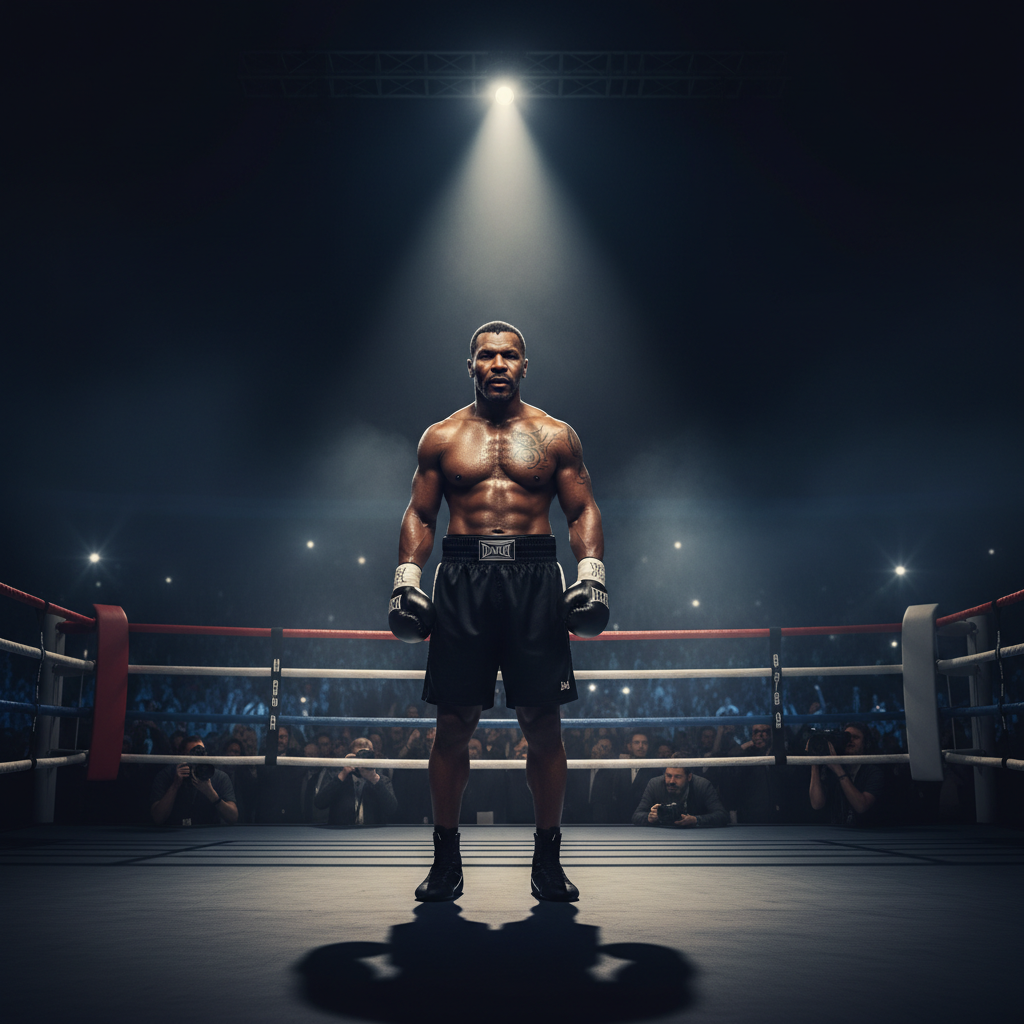
Mike Tyson is arguably one of the most ferocious, controversial, and captivating athletes in the history of sports. Known variously as “Iron Mike”, “Kid Dynamite”, and the “Baddest Man on the Planet”, Tyson’s journey transcends boxing. It is a narrative arc of meteoric rise, catastrophic self-destruction, and an unexpected, philosophical redemption that has kept him in the public eye for over four decades. To understand Tyson is to understand the raw power of human potential and the fragility of fame.
Early Life and Troubled Beginnings
Born Michael Gerard Tyson on June 30, 1966, in Fort Greene, Brooklyn, Tyson’s early years were defined by poverty and instability. His father abandoned the family early on, leaving his mother, Lorna Smith Tyson, to raise Mike and his siblings in the crime-ridden neighborhoods of Bedford-Stuyvesant and Brownsville. By the age of 13, Tyson had been arrested 38 times for petty crimes and fighting, a result of being bullied for his high-pitched voice and lisp.
His life changed forever when he was sent to the Tryon School for Boys in upstate New York. There, Bobby Stewart, a juvenile detention center counselor and former boxer, recognized Tyson’s raw physical potential. Stewart introduced the troubled youth to Cus D’Amato, a legendary boxing trainer who would become Tyson’s legal guardian and father figure. D’Amato didn’t just teach Tyson how to box; he instilled in him a warrior’s discipline and a psychological armor that would later define his ring persona.
The Peek-a-Boo Style and Amateur Career
Under D’Amato’s tutelage, Tyson developed the famous “Peek-a-Boo” style of boxing. This defensive technique involved holding the hands high in front of the face and moving the head rapidly side-to-side to slip punches, allowing Tyson to unleash devastating hooks and uppercuts. Despite his relatively short stature for a heavyweight (5 ft 10 in), his speed and explosive power made him a nightmare for opponents.
Tyson’s amateur career was successful, culminating in gold medals at the 1981 and 1982 Junior Olympic Games. He set a record by knocking out his opponent in just 8 seconds in the 1982 Junior Olympics. Although he failed to make the 1984 Olympic team, losing to Henry Tillman, the setbacks only fueled his drive to turn professional and dominate the heavyweight division.
Professional Debut and Rise to Glory
Mike Tyson made his professional debut on March 6, 1985, at age 18. He defeated Hector Mercedes via a first-round TKO. This set the tone for his early career, where he fought frequently—sometimes twice a month—leaving a trail of unconscious opponents in his wake. In his first year as a pro, he amassed a 15-0 record, winning all by knockout.
Youngest Heavyweight Champion in History
Tragedy struck in November 1985 when Cus D’Amato passed away. Kevin Rooney took over training duties, and Tyson channeled his grief into his training. On November 22, 1986, Tyson faced Trevor Berbick for the WBC Heavyweight title. In a display of terrifying dominance, Tyson knocked Berbick out in the second round. At 20 years, 4 months, and 22 days old, Mike Tyson became the youngest heavyweight champion in history, a record that still stands today.
Undisputed Champion
Tyson did not stop at one belt. He embarked on a mission to unify the division. He defeated James “Bonecrusher” Smith to win the WBA title and Tony Tucker to claim the IBF title. By 1987, he was the undisputed heavyweight champion of the world. Perhaps his most famous performance during this prime era came in 1988 against Michael Spinks. In a battle of undefeated champions, Tyson knocked Spinks out in 91 seconds, cementing his status as an invincible force.
Personal Turmoil and the Buster Douglas Upset
While Tyson was unbeatable in the ring, his personal life was unraveling. His marriage to actress Robin Givens was tumultuous and ended in a highly public divorce. He fired longtime trainer Kevin Rooney and aligned himself with promoter Don King, a move many critics cite as the beginning of his decline. His training discipline waned, and chaos surrounded his camp.
On February 11, 1990, the unthinkable happened. In Tokyo, Japan, Tyson faced 42-to-1 underdog Buster Douglas. Tyson appeared sluggish and unprepared. Although he knocked Douglas down in the eighth round, Douglas rallied to knock Tyson out in the tenth. It remains one of the greatest upsets in sports history and shattered the aura of Tyson’s invincibility.
Prison and Conversion to Islam
Tyson’s troubles escalated legally. In 1991, he was arrested for the rape of Desiree Washington, a Miss Black America contestant. He was convicted in 1992 and sentenced to six years in prison. During his incarceration, Tyson converted to Islam and adopted the name Malik Abdul Aziz, though he continued to use his birth name professionally. He served three years and was released in 1995, returning to a boxing world that eagerly awaited his comeback.
The Holyfield Rivalry and The Bite
Tyson regained the WBC and WBA titles shortly after his release, defeating Frank Bruno and Bruce Seldon. However, the defining rivalry of his post-prison career was against Evander Holyfield. In their first fight in 1996, Holyfield stopped Tyson in the 11th round. The rematch in 1997 became infamous as “The Bite Fight.” Frustrated by headbutts and Holyfield’s resilience, Tyson bit off a piece of Holyfield’s ear, leading to his disqualification and a temporary revocation of his boxing license.
Decline and Retirement
Tyson returned to the ring in 1999 but was clearly past his prime. He secured a title shot against Lennox Lewis in 2002. The buildup was marred by a brawl at a press conference, but in the ring, Lewis systematically dismantled Tyson, knocking him out in the eighth round. Tyson continued to fight sporadically to pay off debts, but after humiliating losses to Danny Williams and Kevin McBride, he retired in 2005. He famously stated, “I don’t have the fighting guts or the heart anymore.”
Reinvention: Acting and Entertainment
Following his retirement, Tyson faced bankruptcy and personal tragedy, including the death of his daughter Exodus. However, he began a slow process of reinvention. His cameo in the 2009 movie The Hangover showed a softer, self-deprecating side that endeared him to a new generation. He launched a successful one-man Broadway show, Mike Tyson: Undisputed Truth, directed by Spike Lee, where he candidly shared his life story.
Business Ventures and Podcasting
Today, Mike Tyson is a successful entrepreneur. He founded Tyson 2.0, a cannabis company that has become a major player in the industry. He also hosts the popular podcast Hotboxin’ with Mike Tyson, where he interviews celebrities and athletes, displaying a level of wisdom, introspection, and calmness that contrasts sharply with his youthful persona.
Legacy and Return to the Ring
Even in his 50s, the allure of the ring remained. In 2020, Tyson fought Roy Jones Jr. in an exhibition match that drew massive pay-per-view numbers. His physical condition stunned fans, proving that the power was the last thing to leave a fighter. His legacy is complex: a mix of unparalleled athletic dominance, cautionary tales of excess, and an inspiring third act of survival and growth.
Mike Tyson’s biography is not just about boxing records; it is about the human condition. From the streets of Brownsville to the pinnacle of global fame, and through the depths of prison and bankruptcy, Tyson has lived a thousand lives. He remains a cultural icon, representing the ultimate story of a fighter who, despite being knocked down by life repeatedly, always found a way to get back up.