

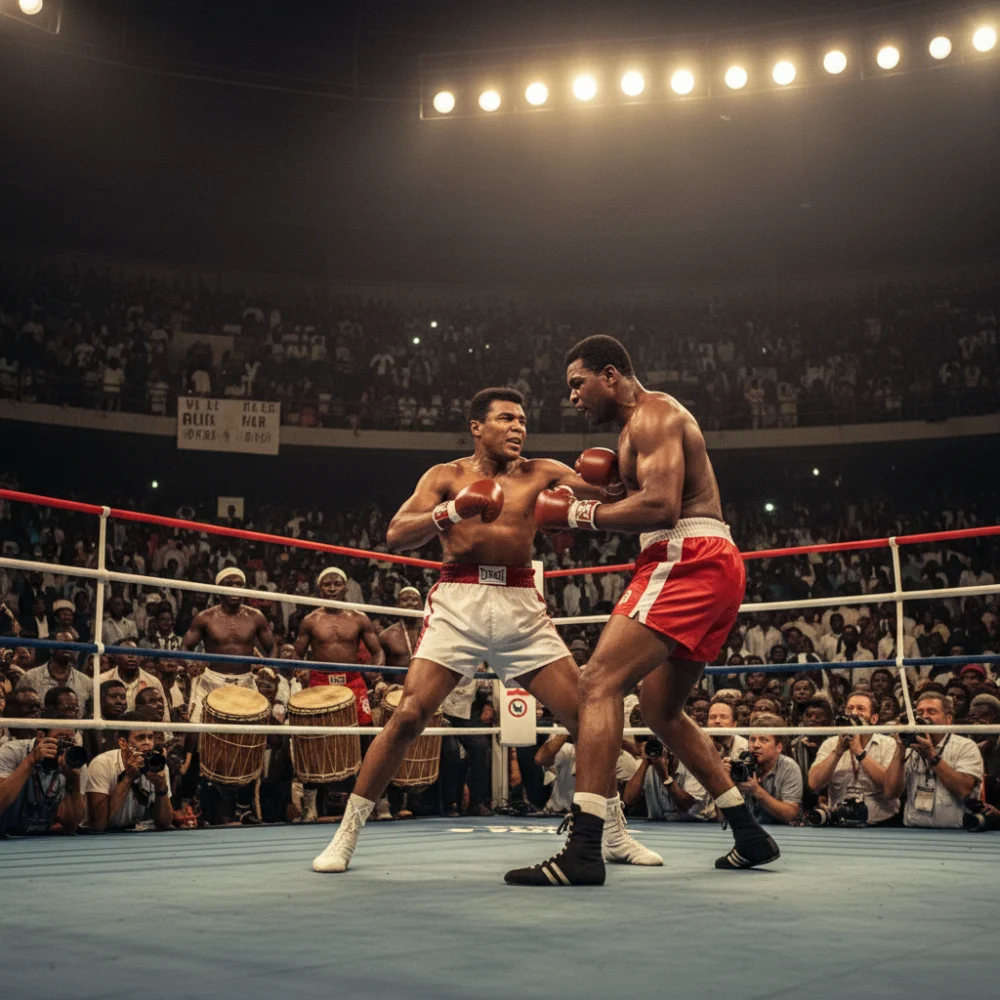
The 1974 Rumble in the Jungle is widely considered the greatest sporting event of the 20th century. Held in Kinshasa, Zaire, it featured a clash between the undefeated, terrifyingly powerful champion George Foreman and the aging former champion Muhammad Ali. While the world expected a brutal knockout in favor of Foreman, the fight became a masterclass in tactical intelligence and psychological resilience.
The Context of an Impossible Challenge
Entering the ring, George Foreman was the undisputed heavyweight champion of the world. He had decimated Joe Frazier and Ken Norton, the only two men to have beaten Ali at that point, in just two rounds each. Foreman was younger, stronger, and possessed a level of punching power that seemed supernatural. Most experts believed Ali’s career would end in a tragic knockout, as his once-legendary speed had visibly slowed with age.
Ali, however, possessed an analytical mind that saw beyond physical statistics. He understood that to beat a man like Foreman, he could not rely on traditional boxing mechanics. He needed to dismantle Foreman’s psyche and stamina before he could hope to dismantle his physical defense. This realization laid the groundwork for one of the most sophisticated strategic gambles in sports history.
Psychological Warfare: Ali Bomaye
Ali’s intelligence was evident long before the first bell rang. He spent weeks in Zaire immersing himself in the local culture, winning the hearts of the Congolese people. By the time the fight occurred, the stadium was filled with thousands of fans chanting Ali Bomaye (Ali, kill him). This created an atmosphere of isolation for Foreman, who felt like an outsider in a foreign land, while Ali was buoyed by the energy of the crowd.
Furthermore, Ali’s constant taunting during the pre-fight build-up was not just for show. He was intentionally goading Foreman into a state of rage. Ali knew that an angry fighter is a predictable fighter. By making Foreman want to destroy him, Ali ensured that Foreman would come out swinging with maximum force, neglecting the patience and technical discipline required for a long-distance fight.
The Birth of the Rope-a-Dope
As the fight began, the world was shocked. Instead of dancing around the ring as he did in his youth, Ali backed himself against the ropes. This was the birth of the Rope-a-Dope strategy. To the casual observer, it looked like Ali was being trapped and beaten. In reality, Ali was using the elasticity of the ropes to absorb the impact of Foreman’s devastating body blows.
The intelligence behind this move was multi-layered:
- Energy Conservation: Ali stayed stationary, allowing Foreman to do all the work.
- Impact Absorption: By leaning back, Ali increased the distance Foreman’s punches had to travel, reducing their kinetic energy.
- Psychological Drain: Foreman was landing hundreds of punches, yet Ali remained standing and taunting him, which led to Foreman’s growing frustration and exhaustion.
The Tactical Shift in the Early Rounds
During the first three rounds, Ali occasionally threw lead right hands—a highly unconventional and risky move in boxing. This was a calculated risk designed to confuse Foreman. By landing these sharp, unexpected shots, Ali kept Foreman honest and prevented him from simply walking through Ali’s defense without fear of retaliation.
As the rounds progressed, the heat and humidity of Kinshasa began to take their toll. Foreman, who had never been forced to fight past the early rounds during his championship reign, began to breathe heavily. His movements became sluggish, and the snap in his punches disappeared. Ali, sensing the shift in momentum, began to increase his verbal assault, whispering in Foreman’s ear during clinches, asking, Is that all you got, George?
Ring Generalship and Spatial Awareness
Ali’s intelligence also manifested in his mastery of the ring’s geography. Even while on the ropes, he maintained control over the angle of the fight. He used his arms to parry Foreman’s hooks and clinched at strategic moments to disrupt Foreman’s rhythm. This prevented Foreman from setting his feet and delivering the full leverage of his power.
By the fifth round, the tide had completely turned. Foreman was visibly spent, his arms heavy as lead. Ali, despite having taken a significant amount of punishment to the body, remained mentally sharp. He began to open up with combinations, targeting Foreman’s face which was now unprotected due to exhaustion. The brilliance of the strategy was now clear: Ali had traded physical punishment for a tactical advantage.
The Climax: The Eighth Round Knockout
The eighth round remains one of the most iconic sequences in boxing history. Ali, seeing that Foreman was completely drained, finally stepped off the ropes. He landed a stinging combination that culminated in a devastating right hand. As Foreman spun and collapsed to the canvas, Ali stood over him, choosing not to throw an extra punch as Foreman fell—a final display of his supreme awareness and control.
The Aftermath and Tactical Legacy
The Rumble in the Jungle changed the way boxing was analyzed. It proved that intelligence, preparation, and psychological fortitude could overcome raw physical dominance. Ali did not win because he was stronger; he won because he was smarter. He understood the physics of the ropes, the biology of stamina, and the psychology of his opponent.
Foreman would later admit that he was beaten by a superior mind. The loss initially devastated him, but it eventually led to his own transformation and his legendary comeback decades later. For Ali, the victory cemented his status as The Greatest, not just for his athletic ability, but for his peerless boxing IQ.
Conclusion: A Lesson in Strategic Brilliance
The Rumble in the Jungle serves as a timeless lesson for any discipline. It teaches us that when faced with an overwhelming force, one must adapt, innovate, and use the opponent’s strength against them. Muhammad Ali’s performance in Zaire was more than a fight; it was a psychological and tactical masterpiece that remains the gold standard for strategic excellence in the world of sports.