
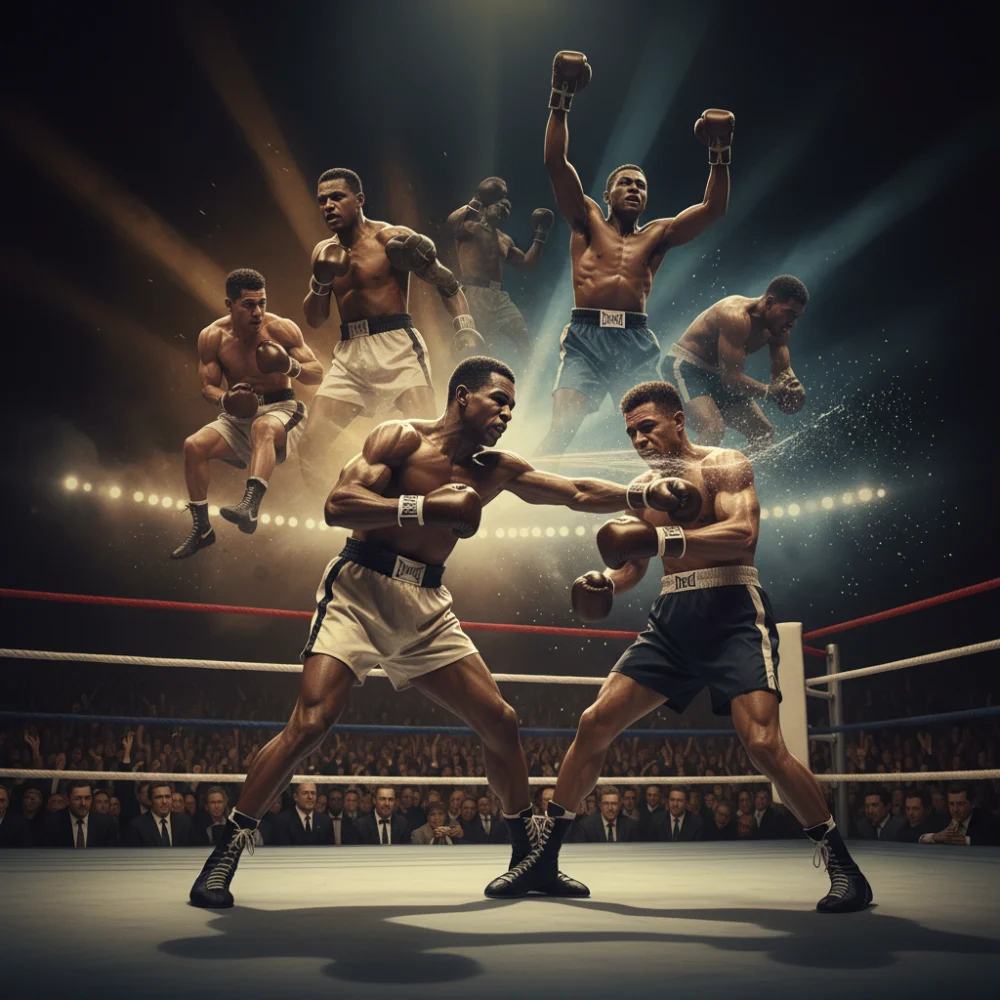
Sugar Ray Robinson is widely considered the greatest boxer to ever lace up a pair of gloves. While modern fans often talk about his legendary series with Jake LaMotta or his middleweight wars with Gene Fullmer and Carmen Basilio, there is a vast catalog of fights from his prime that remain largely unseen by the casual observer. These bouts, occurring mostly during his dominant welterweight run, showcase a level of speed, power, and technical proficiency that has arguably never been matched in the history of the sport.
The 1940s represented the absolute physical peak of Robinson. During this decade, he amassed a record that looks like a statistical anomaly today. To understand the greatness of Robinson, one must look past the grainy films of his later years and into the accounts of his welterweight supremacy, where he was described as a whirlwind of athletic perfection, combining the grace of a dancer with the knockout power of a heavyweight.
The Passing of the Torch: Robinson vs. Henry Armstrong (1943)
In 1943, Robinson faced the legendary Henry Armstrong. While Armstrong was past his prime, this fight represented a symbolic passing of the torch between two of the greatest to ever do it. Robinson, out of respect for his idol, reportedly carried Armstrong at times, yet the technical display of counter-punching and movement from Sugar Ray was a sight to behold. It remains a historical cornerstone that lacks the cinematic preservation it deserves.
The First Title Win: Robinson vs. Tommy Bell (1946)
Many fans forget that Robinson had to wait years for a title shot due to the political climate of boxing at the time. When he finally faced Tommy Bell for the vacant Welterweight Championship in 1946, it was a 15-round classic. Robinson was knocked down early but rose to dominate the later rounds with a display of stamina and grit. This fight proved that Robinson was not just a front-runner but a warrior who could overcome adversity.
Dealing with the Dirty Tactics: Robinson vs. Fritzie Zivic (1941)
Fritzie Zivic was known as one of the dirtiest fighters in history, utilizing thumbs, elbows, and low blows. Robinson faced him twice in 1941. In their first encounter, Robinson outboxed the veteran with such ease that it shocked the boxing world. He dismantled Zivic’s roughhouse tactics with a sharp jab and superior footwork, proving that pure skill could overcome the darkest arts of the ring.
The Masterclass Against Charley Fusari (1950)
By 1950, Robinson was a seasoned veteran of nearly 110 fights. His defense against Charley Fusari was a masterclass in the “sweet science.” Robinson didn’t just win; he toyed with a top-tier contender, showcasing his ability to lead and counter simultaneously. This fight is often overlooked because it occurred just before his famous move to the middleweight division, yet it captures Robinson at his most efficient.
The technical breakdown of Robinson during this era reveals a fighter who utilized a pendulum step long before it was a common term in boxing gyms. He could move backward and still generate enough torque to score a knockout. His ability to throw a five-punch combination in the span of a single second made him a nightmare for the defensive specialists of the 1940s.
The European Challenge: Robinson vs. Robert Villemain (1950)
Robinson’s tour of Europe is often remembered for his loss to Randy Turpin, but his fight against Robert Villemain in Pennsylvania earlier that year was a grueling test. Villemain was a rugged, pressure fighter who forced Robinson to use every ounce of his boxing IQ. Robinson eventually won a clear decision, but the fight highlighted his ability to adapt to different styles across different continents.
The Quickest Destruction: Robinson vs. Jose Basora (1950)
In a rematch of a 1945 draw, Robinson faced Jose Basora for the Pennsylvania version of the middleweight title. Robinson made a statement by knocking Basora out in just 52 seconds of the first round. It remains one of the fastest knockouts in championship history and serves as a terrifying reminder of the explosive power Robinson carried in both hands.
The Rivalry Before the Fame: Robinson vs. Kid Gavilan I (1948)
Before Kid Gavilan became the “Bolo Punch” king and a legend in his own right, he was a young challenger pushing Robinson to the limit. Their first fight in 1948 was a high-speed chess match. Robinson won via unanimous decision, but the sheer volume of punches thrown by both men was staggering. This fight is a prime example of the high-level competition Robinson faced on a monthly basis.
One of the most remarkable aspects of Robinson’s career was his activity level. He often fought twice a month, sometimes against top-ten contenders. This constant state of competition kept his timing razor-sharp. Unlike modern fighters who have long camps, Robinson lived in the ring, making his boxing instincts second nature.
Setting the Stage: Robinson vs. Bobo Olson I (1950)
While their later fights are better documented, the first meeting between Robinson and Carl “Bobo” Olson was a tactical beauty. Robinson’s ability to negate Olson’s strength with lateral movement and sharp uppercuts was a precursor to his dominance in the middleweight division. It was a clear demonstration of why Robinson was the pound-for-pound king regardless of the weight class.
The primary reason many of these fights are “never watched” is the lack of high-quality film. Many 1940s reels were lost to time, fire, or poor storage. However, the radio broadcasts and detailed newspaper accounts from the era paint a picture of a fighter who was physically superior to his peers in every measurable way, from reach to reaction time.
Robinson’s legacy is built on a foundation of 128 wins with only one loss (to LaMotta, which he later avenged five times) during his prime. These unseen fights are the bricks that make up that foundation. They represent the grueling schedule and the diverse array of styles he had to overcome to be recognized as the greatest of all time.
In conclusion, while we may never have 4K footage of Sugar Ray Robinson dismantling the welterweight division, the records and stories of these forgotten battles serve as a testament to his greatness. He was a fighter who combined the best elements of every era: the toughness of the pioneers and the technical brilliance of the modern age. Truly, there will never be another Sugar Ray.