


When boxing historians discuss Mike Tyson, the conversation almost invariably centers on his terrifying power. The image of opponents crumbling to the canvas, eyes rolled back, often overshadows the intricate science that facilitated those outcomes. However, to view Tyson merely as a brawler with heavy hands is to misunderstand the essence of his dominance. Tyson was a technical savant, a fighter whose knockout ratio was the result of sophisticated mechanics, leverage, and timing rather than brute strength alone.
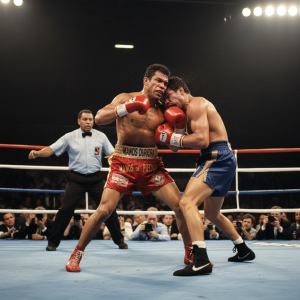
The foundation of Tyson’s success was the Peek-a-Boo style, a complex defensive and offensive system developed by his legendary trainer, Cus D’Amato. This style was designed specifically for a shorter heavyweight to close the distance against taller opponents with longer reaches. Unlike traditional upright stances, the Peek-a-Boo required Tyson to keep his gloves high against his cheeks, elbows tucked tight to his ribs, and his head in constant motion.
The Art of Head Movement
The most distinctive aspect of Tyson’s technical genius was his elusive head movement. He utilized a pendulum-like motion, slipping constantly from side to side. This wasn’t just defensive posturing; it was a loading mechanism. Every time Tyson slipped a jab to the right, he was simultaneously loading his weight onto his right hip, coiling his body like a spring to unleash a devastating counter-hook or uppercut. This efficiency of motion meant that his defense was the trigger for his offense.
Many observers missed the subtlety of how Tyson used the slip-bag in training to perfect this rhythm. He wasn’t reacting to punches; he was anticipating them. By moving his head before the punch was thrown, he made himself a moving target that was incredibly difficult to hit clean. When an opponent missed, they were often left off-balance and exposed, creating the perfect opening for Tyson’s short, compact punches.
leverage and Kinetic Linking
Tyson’s power was derived from exceptional leverage. Because he was often shorter than his opponents, he punched upwards. In boxing physics, punching upward from a crouched position allows a fighter to utilize the power of their legs and glutes more effectively than punching downward. Tyson would drive through the floor, transferring force from his ankles to his hips, through his torso, and finally into the fist at the moment of impact.
This kinetic linking is what separated him from other heavy hitters. While others swung with their arms, Tyson threw punches with his entire body. His signature right hook to the body followed by a right uppercut to the chin is a textbook example of this weight transfer. He would dip low, ripping the body shot to bring the opponent’s guard down, and then use the upward momentum to launch the uppercut with devastating force.
The D’Amato Shift
Footwork is the unsung hero of Tyson’s knockout reel. He employed a technique often referred to as ‘shifting’ or the ‘D’Amato Shift.’ This involved squaring his stance or switching leads mid-combination to cut off the ring and create new angles of attack. By stepping outside his opponent’s lead foot, he could land power shots from angles that blind-sided his adversaries.
- The Gazelle Punch: Tyson often used a leaping left hook, propelling himself off both feet to close the gap instantly.
- Square Stance: Unlike traditional boxers who stay bladed, Tyson would square up on the inside to throw hooks with equal power from both hands.
- Cutting the Ring: He didn’t follow opponents; he herded them into corners where his short-range dominance was inescapable.
This aggressive footwork required immense cardiovascular conditioning and leg strength. Tyson’s ability to explode forward covered the distance before taller opponents could establish their jab. Once inside the ‘pocket,’ Tyson’s shorter arm length became an advantage, allowing him to generate maximum torque in tight spaces where lankier fighters were jammed up and unable to extend their arms.
Speed Kills
While power is the headline, speed was the killer. Tyson’s hand speed was anomalous for a heavyweight. He threw combinations with the velocity of a lightweight. This speed overwhelmed the central nervous system of his opponents; they simply couldn’t process the visual information fast enough to react. A three-punch combination would land before the opponent could register the first hit.
Accuracy played a pivotal role alongside speed. Tyson was a precision puncher. He targeted the chin, the temple, and the floating ribs. He rarely wasted energy on blocked shots. If an opponent covered up, Tyson would attack the body relentlessly until the guard lowered. His ability to thread the needle through a tight defense showcased his sharp eyes and ring IQ.
Psychological warfare was also technically integrated into his style. The constant movement, the refusal to take a step back, and the sheer volume of feints created a sensory overload for the other fighter. Tyson defeated many opponents before the first bell rang, but this intimidation was sustained by the reality that his technical skills gave him an answer for every defensive tactic they attempted.
The Number System
Cus D’Amato taught Tyson using a ‘number system’ for punches, similar to how a musician learns scales. This drilled specific combinations into Tyson’s muscle memory until they became instinctual. For example, a ‘7-2-3’ might correspond to a specific sequence of hooks and crosses. In the heat of battle, Tyson didn’t have to think; his body reacted automatically to openings with pre-programmed, high-percentage combinations.
Analyzing his knockout of Michael Spinks, one can see the culmination of all these technical elements. The footwork to close the distance, the head movement to evade the counter, the body mechanics to generate power in a short space, and the accuracy to land flush on the chin. It lasted 91 seconds, but it was a masterclass in boxing physics.
Ultimately, to label Mike Tyson solely as a puncher is to ignore the years of discipline and study that went into his craft. He was a student of boxing history who absorbed the techniques of Jack Dempsey and Henry Armstrong. His genius lay in applying these old-school principles with modern athleticism.
The knockouts were the result, but the process was pure technical brilliance. Tyson proved that in the sweet science of boxing, technique amplifies power, and defense creates offense. His legacy remains a testament to the effectiveness of the Peek-a-Boo style when executed with perfection.