

In the pantheon of boxing legends, few names evoke a visceral sense of danger quite like Roberto Durán. Known globally by his moniker, ‘Manos de Piedra’ or ‘Hands of Stone’, the Panamanian icon is often remembered for his raw power and ferocious temperament. However, to label Durán merely as a brawler is a significant disservice to his genius. He was a pugilist who fundamentally redefined what it meant to be an aggressive fighter, blending primal savagery with a boxing IQ that rivaled the most technical purists of his era.
Durán’s career, spanning five decades, serves as a masterclass in the art of pressure fighting. Before Durán, aggression was often synonymous with recklessness—a willingness to take two punches to land one. Durán flipped this script entirely. He demonstrated that a fighter could move forward relentlessly without sacrificing defensive integrity. His aggression was not blind; it was calculated, surgical, and suffocating, creating a blueprint for inside fighting that is still studied by coaches and boxers today.
The Science Behind the Savagery
What separated Durán from other heavy hitters was his sophisticated ring generalship. He did not simply chase his opponents; he cut off the ring with geometric precision. By using subtle footwork to deny escape routes, he forced adversaries into the ropes or corners where his close-range arsenal was most devastating. This ability to shrink the canvas turned the ring into a claustrophobic trap for even the most elusive movers.
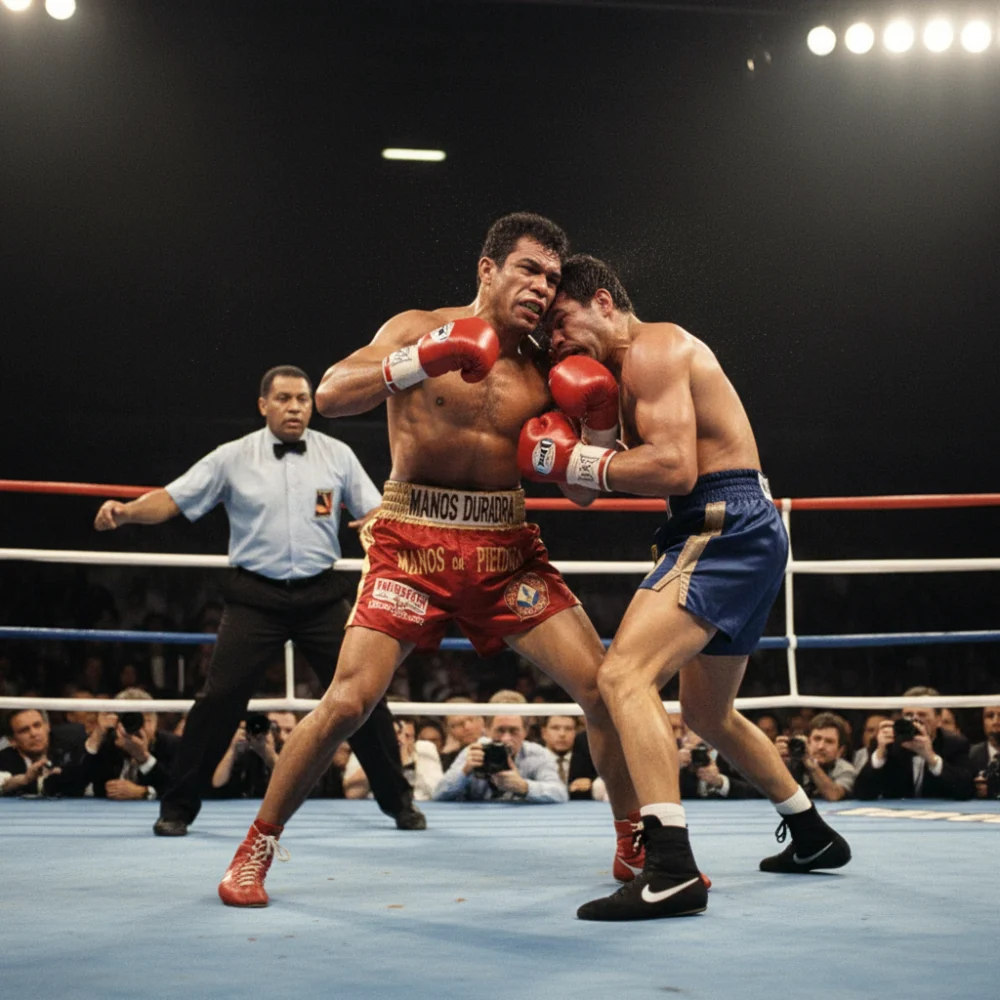
Once inside, Durán utilized a technique that redefined the ‘pocket’. While many fighters clinch when they get too close, Durán thrived in that intimate space. He understood leverage and positioning better than perhaps any lightweight in history. He would rest his head on an opponent’s shoulder or chest, using it as a pivot point to leverage short, powerful hooks and uppercuts that traveled only inches but landed with concussion-inducing force.
Defense as a Weapon of Aggression
Perhaps the most overlooked aspect of Durán’s aggression was his defense. It is a common misconception that defensive fighters must retreat. Durán proved that defense could be an offensive tool. He possessed an uncanny ability to slip punches by mere millimeters while stepping forward. This slipping was not just about avoidance; it was about loading up his own counter-punches. A missed jab from an opponent was an immediate invitation for a Durán right hand over the top.
His mastery of parrying and rolling with punches allowed him to stay in the danger zone without absorbing significant punishment. He would catch punches on his gloves and shoulders, instantly returning fire before the opponent could reset. This constant presence—the feeling that he was always right in front of you, unhurt and ready to strike—broke the will of many fighters long before the final bell.
Psychological Warfare and Intimidation
Roberto Durán’s aggression began before the first bell rang. He was a master of psychological warfare, projecting an aura of animalistic intensity that unnerved his rivals. His stare-downs were legendary, often described as looking into the eyes of a predator. This intimidation factor meant that many opponents entered the ring already defeated, their fight-or-flight response triggered by Durán’s sheer presence.
Inside the ring, he utilized roughhouse tactics that bordered on the illegal but were executed with veteran savvy. He would use his forearms, elbows, and head to make opponents uncomfortable, dragging them into a street fight where his temperament reigned supreme. This psychological dominance forced technical boxers to abandon their game plans and engage in a brawl—a battle they were destined to lose against ‘Manos de Piedra’.
The Montreal Brawl: A Tactical Masterpiece
The definitive example of Durán’s redefined aggression was his first bout against Sugar Ray Leonard in Montreal in 1980. Leonard was the golden boy, the speedster, the matador. Durán, playing the bull, did not charge blindly. Instead, he systematically dismantled Leonard’s movement. He attacked the body relentlessly to slow Leonard down and used feints to freeze the faster man.
In that fight, Durán forced Leonard to fight a flat-footed war. By cutting off the ring and slipping Leonard’s rapid-fire combinations, Durán made Leonard feel that his speed was nullified. It was a victory of intelligent pressure over dazzling athleticism, proving that a swarmer could out-box a boxer if the pressure was applied with enough technical skill.
Longevity Through Adaptation
Durán’s unique style allowed him to compete at the highest level far longer than most pressure fighters. Typically, swarmers burn out early as their reflexes fade. However, because Durán’s aggression was built on defensive responsibility and timing rather than just speed and chin, he remained dangerous well into his 40s. His victory over Iran Barkley for the middleweight title—a fight where he was physically smaller and older—showcased his enduring ability to slip, counter, and brawl effectively.
Even as he moved up through weight classes—from lightweight to middleweight and beyond—the core of his style remained. He proved that the principles of controlled aggression, head movement, and body punching were universal languages in boxing, effective against giants and speedsters alike.
The Lasting Legacy of ‘Manos de Piedra’
Today, Roberto Durán’s influence is visible in the styles of many modern champions. Fighters who excel at cutting off the ring and working on the inside, such as Julio César Chávez in the 90s or modern pressure fighters, owe a debt to the blueprint Durán established. He showed that being aggressive is not about anger; it is about control.
Ultimately, Roberto Durán redefined aggression by marrying it with the sweet science. He took the violence of a brawl and applied the discipline of a grandmaster. In doing so, he created a legacy that transcends his record, standing forever as the gold standard for how to dismantle an opponent with pressure, power, and panic-inducing skill.