
On February 11, 1990, inside the Tokyo Dome in Japan, the world of professional sports witnessed an event so improbable that it remains the benchmark for all underdogs. It was the night James ‘Buster’ Douglas, a journeyman heavyweight with a reputation for quitting when the going got tough, stepped into the ring against the undefeated, undisputed heavyweight champion of the world, Mike Tyson. Tyson was not just a champion; he was a cultural phenomenon, a wrecking machine who had destroyed his previous opponents with terrifying ease. The odds against Douglas were a staggering 42-to-1, with few casinos even bothering to take action on the fight.
The Aura of Invincibility
To understand the magnitude of this upset, one must remember who Mike Tyson was in 1990. ‘Iron’ Mike was 37-0 with 33 knockouts. He had unified the heavyweight titles and was considered unbeatable. His style, a ferocious blend of speed, power, and intimidation, induced panic in opponents before the first bell even rang. Famous fighters like Michael Spinks had been decimated in 91 seconds. The general consensus among pundits and fans alike was that the fight in Tokyo was merely a tune-up for a highly anticipated mega-fight against Evander Holyfield. Tyson himself admitted later that he barely trained, spending more time partying than sparring, believing his reputation alone would secure the victory.
A Fighter with Nothing to Lose
In stark contrast to Tyson’s celebrity lifestyle, Buster Douglas entered the ring carrying the weight of profound personal tragedy. Just 23 days before the fight, his mother, Lula Pearl, passed away. She had been his rock and his biggest supporter. While the media focused on Tyson’s lack of preparation, they overlooked Douglas’s newfound, steely resolve. He wasn’t fighting for money or fame; he was fighting to honor his mother’s memory. This emotional catalyst transformed a talented but inconsistent boxer into a focused warrior who refused to be intimidated by the man standing across from him.
The Opening Bell: A Change in the Script
From the very first round, it was clear that this was not the typical Mike Tyson fight. Douglas, utilizing his significant reach advantage, established a sharp, stinging jab that kept Tyson at bay. Unlike previous opponents who froze in fear, Douglas moved laterally, circling away from Tyson’s power hand and disrupting the champion’s rhythm. Tyson, expecting a quick surrender, looked baffled. He marched forward with little head movement, eating stiff jabs that began to swell his left eye almost immediately.
As the rounds progressed, the crowd in the Tokyo Dome fell into a hushed disbelief. Douglas was not just surviving; he was winning. He was beating Tyson to the punch, tying him up on the inside, and landing clean combinations. Tyson’s corner, led by Aaron Snowell and Jay Bright, seemed ill-equipped to handle the crisis. In a now-infamous detail of the fight, they had forgotten the enswell (the metal iron used to reduce swelling) and were forced to use a rubber glove filled with ice water to treat Tyson’s rapidly closing eye.
The Controversial Eighth Round
The drama reached a fever pitch in the eighth round. Tyson, desperate and essentially fighting with one eye, landed a massive right uppercut that sent Douglas crashing to the canvas. It was the moment everyone had expected. Douglas lay flat on his back, pounding the canvas in frustration. However, what followed became a point of massive controversy. The referee, Octavio Meyran, began the count, but due to a miscommunication with the timekeeper, the count was arguably slow. Douglas rose at the count of nine—though approximately 13 seconds had elapsed—and the fight continued. Tyson fans would argue for decades that the fight should have ended there.
However, surviving the knockdown seemed to galvanize Douglas. While Tyson expended his last reserves of energy trying to finish the job, Douglas recovered his legs. He came out for the ninth round with renewed ferocity, battering a now-exhausted Tyson. The champion was staggering, his face swollen, his defenses gone. The ‘Baddest Man on the Planet’ was suddenly mortal, and Douglas sensed that history was within his grasp.
The Tenth Round: History Made
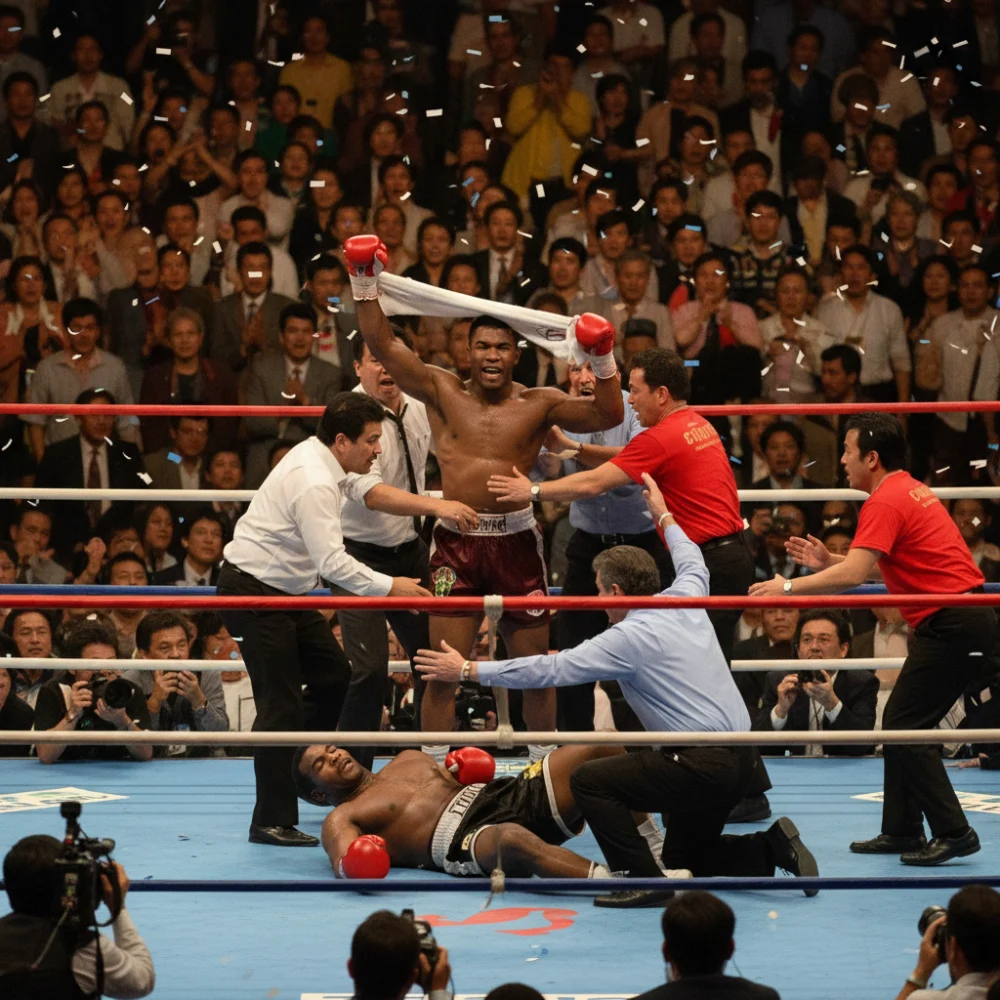
The climax arrived in the tenth round. Tyson, still looking for that one punch to save his title, walked into a brutal uppercut from Douglas that snapped his head back. Douglas followed instantly with a rapid-fire four-punch combination: a left, a right, a left, and a final, crushing left hook. Tyson collapsed. The image of Mike Tyson fumbling on the canvas, trying to put his mouthpiece back in while disoriented, remains one of the most iconic visuals in sports history.
Referee Octavio Meyran reached the count of ten, and waved the fight off. Buster Douglas raised his arms in victory, tears streaming down his face. In the post-fight interview, when asked how he managed to win, Douglas simply replied, ‘For my mother.’ It was a poignant end to a violent contest, grounding the monumental athletic achievement in deep personal emotion.
The Aftermath and Controversy
The immediate aftermath was chaotic. Promoter Don King and Tyson attempted to protest the result, citing the ‘long count’ in the eighth round. They argued that the result should be voided. However, public outcry and the governing bodies eventually upheld Douglas’s victory. The world recognized that Douglas had dominated the fight statistically and tactically. To strip him of the title would have been a travesty of justice. The protest was withdrawn, and Douglas was officially the undisputed heavyweight champion.
Why Douglas Won: Tactical Brilliance
Analyzing the fight from a technical perspective, Douglas’s victory was built on several key factors:
- The Jab: Douglas used his 12-inch reach advantage perfectly, preventing Tyson from getting inside.
- Lateral Movement: He refused to be a stationary target, constantly turning Tyson.
- Psychological Fortitude: He showed no fear, trading punches with Tyson whenever the champion attacked.
- Conditioning: Despite the knockdown, Douglas was in the best shape of his life, while Tyson faded late.
The Legacy of the Upset
Buster Douglas’s reign as champion was short-lived. He would lose the title in his very next defense against Evander Holyfield, showing up overweight and unprepared, reverting to the inconsistencies that plagued his earlier career. However, nothing could erase what happened in Tokyo. That single night defined his legacy. He proved that on any given day, with the right motivation and game plan, the impossible is attainable.
For Mike Tyson, the loss shattered the cloak of invincibility. Although he would win titles again, he was never looked at with the same terrifying reverence. The Douglas fight exposed his vulnerabilities: a lack of discipline, a reliance on intimidation, and technical flaws when forced to fight on the back foot. It marked the beginning of a tumultuous decade for Tyson, both inside and outside the ring.
Today, ‘Tyson vs. Douglas’ is shorthand for the ultimate underdog story. It is referenced in business, sports, and pop culture whenever a dominant force is toppled by an unlikely challenger. The fight serves as a timeless reminder that in boxing, as in life, reputation does not win battles—performance does.