

In the history of combat sports, few figures have cast a shadow as long and as terrifying as Mike Tyson during the mid-to-late 1980s. Before the prison sentence, the ear-biting incident, and the tabloid chaos, there was simply "Kid Dynamite." To watch Tyson in his prime was to witness a force of nature that seemed to defy the conventional physics of heavyweight boxing. He was a compact ball of muscle who moved with the agility of a lightweight and hit with the impact of a freight train.
Understanding the magnitude of Tyson’s dominance requires looking beyond the knockout highlight reels. It requires a deep dive into the mechanics of his movement, the psychological atmosphere he cultivated, and the specific training regimen implemented by his mentor, Cus D’Amato. This period, roughly spanning from his professional debut in 1985 to the dismissal of trainer Kevin Rooney in 1988, represents the apex of his capabilities as a pugilist.
The Architecture of Violence: The Peek-a-Boo Style
The foundation of Tyson’s early success was the "Peek-a-Boo" style, a defensive and offensive system perfected by Cus D’Amato. Unlike traditional heavyweights who stood tall and jabbed from a distance, Tyson was undersized at roughly 5 feet 10 inches. To compensate, D’Amato taught him to keep his gloves high against his cheeks, elbows tight to the body, and head in constant motion. This was not merely about defense; it was a loading mechanism for devastating counter-attacks.
The constant bobbing and weaving served a dual purpose. First, it made Tyson an incredibly difficult target to hit cleanly. Opponents would swing at where his head was, only to find empty air as Tyson slipped underneath. Second, the momentum generated from slipping a punch loaded his hips and shoulders for a return fire. When Tyson slipped a right hand, he was perfectly positioned to unleash a leaping left hook, a punch that became his signature finisher.
This style required immense physical conditioning and discipline. It relied on a strong lower back and legs to maintain the perpetual motion required to close the distance against taller opponents with longer reaches. During his prime, Tyson executed this style with robotic precision, slipping punches by mere inches before exploding upward with combinations that often ended fights in seconds.
Unnatural Speed for a Heavyweight
While his power is legendary, it was Tyson’s hand speed that truly overwhelmed his opposition. Heavyweight boxing is typically characterized by slower, thudding blows. Tyson disrupted this rhythm entirely. He threw combinations with the velocity of a welterweight, often landing three or four punches before his opponent could react to the first one.
The Kinetic Chain: Tyson’s speed was not just in his hands; it was in his feet and hips. He mastered the art of shifting his weight instantly, allowing him to pivot around opponents and attack from angles they couldn’t defend. This footwork allowed him to cut off the ring effectively, trapping victims in the corners where his short, compact hooks did the most damage.
One of the most terrifying aspects of his speed was his ability to double up on hooks with the same hand. He would throw a left hook to the body and, in the same fluid motion, bring a left hook to the head. This technique, rare in the heavyweight division due to the balance required, devastated opponents who dropped their guard to protect their ribs, leaving their chins exposed.
The Psychology of Fear
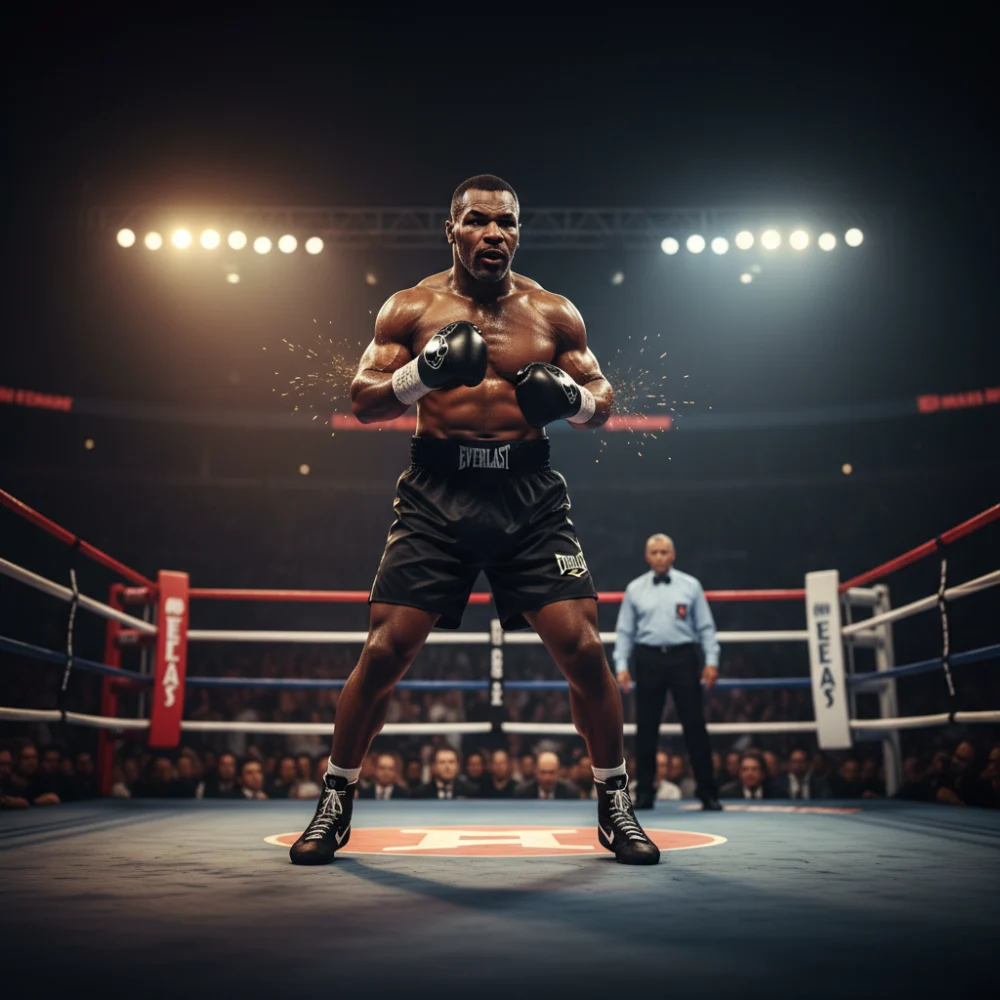
Tyson won many of his fights before the first bell ever rang. The psychological warfare he waged was as potent as his uppercut. In an era of flashy robes and elaborate ring entrances, Tyson stripped everything down to a menacing minimalism. He entered the arena to a singular, droning noise or discordant music, wearing a white towel with a hole cut in it, black trunks, and black shoes with no socks.
This visual presentation projected the image of an executioner rather than an athlete. He didn’t smile, he didn’t wave, and he stared across the ring with an intensity that unsettled even veteran fighters. Michael Spinks, an undefeated champion, famously looked visibly shaken before his 1988 bout with Tyson, a fight that lasted only 91 seconds.
Tyson’s aura of invincibility forced opponents to fight scared. When a boxer fights with fear, they hesitate. They react slower. They abandon their game plans. Tyson capitalized on this hesitation, swarming them immediately and confirming their worst nightmares within the opening moments of the round.
The Zenith: Berbick and Spinks
Two fights define the absolute peak of Mike Tyson’s career before the fall. The first was against Trevor Berbick in 1986. At just 20 years old, Tyson dismantled the WBC champion with brutal efficiency. The knockout sequence, where Berbick attempted to stand up twice only to collapse back to the canvas due to lost equilibrium, showcased the concussive reality of Tyson’s power.
The second defining moment was the unification bout against Michael Spinks. This was billed as a competitive super-fight, but Tyson treated it like a demolition job. He utilized head movement to evade Spinks’ awkward style, closed the gap instantly, and delivered a body shot followed by a head shot that ended the contest. It is widely considered the single greatest performance of his career.
The Beginning of the Decline
The fall of Mike Tyson was not immediate, but the cracks began to show when the discipline of the D’Amato era eroded. The firing of Kevin Rooney, the trainer who held him to the strict Peek-a-Boo regimen, marked a turning point. Without Rooney in his corner, Tyson slowly stopped moving his head. He began to rely more on one-punch knockout power rather than setting up shots with combinations and elusive movement.
Technically, he became a “head-hunter,” looking for the knockout blow rather than working the body to open up the head. His feet became more stationary, making him an easier target for taller fighters who could jab and hold. This gradual erosion of technique culminated in the massive upset loss to Buster Douglas in Tokyo in 1990.
However, looking back at the years 1985 to 1988, sports fans witnessed a unique convergence of physical gifts and technical mastery. Mike Tyson in his prime remains the gold standard for controlled aggression, a fighter who combined the speed of a cheetah with the power of a bear, creating a legacy of destruction that may never be replicated in the heavyweight division.