
In the pantheon of boxing history, few names resonate with the visceral power and cultural significance of Julio César Chávez. Often referred to as El César del Boxeo, Chávez is not merely a sports figure in Mexico; he is a national deity. His career, spanning over two decades, is a testament to endurance, ferocity, and an unbreakable will. To understand his immortality, one must look beyond his impressive record and examine the bond he forged with the Mexican people through blood, sweat, and triumph.
From Humble Beginnings to the Squared Circle
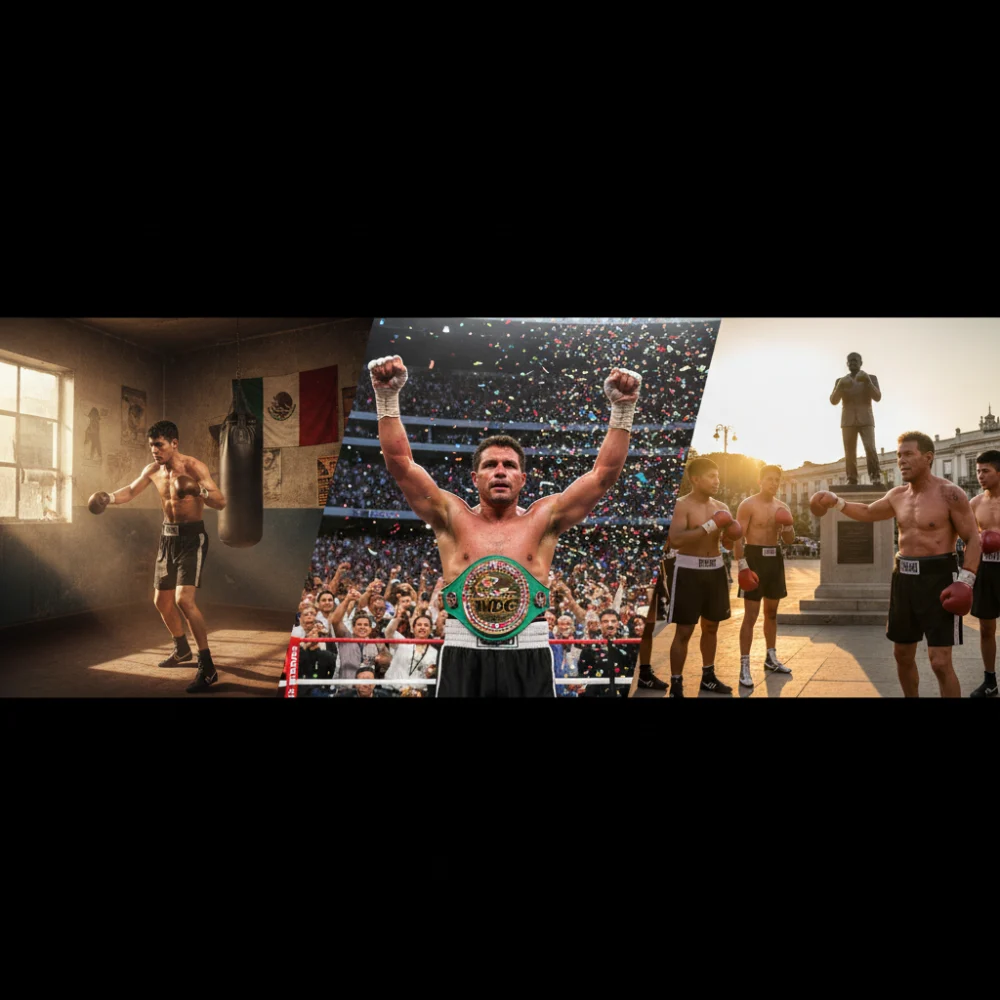
The story of Chávez is the quintessential underdog tale. Born in Ciudad Obregón, Sonora, and raised in Culiacán, Sinaloa, he grew up in extreme poverty. His family lived in an abandoned railroad car, a setting that forged the hunger and desperation often seen in the world’s greatest fighters. Chávez originally took up boxing not for glory, but to buy his mother a house and pull his family out of destitution. This primal motivation fueled his early years, driving him to fight with a ferocity that suggested his very survival was at stake in every round.
Turning professional in 1980 at the age of 17, Chávez embarked on a journey that would see him dismantle opponents with surgical precision. His early career was marked by a relentless schedule, fighting frequently in local arenas across Mexico. These formative years were crucial in developing his signature style: a relentless forward march that suffocated opponents and broke their spirits long before it broke their bodies.
The Anatomy of the Mexican Style
Chávez is widely credited with perfecting what is known globally as the Mexican Style of boxing. This approach is characterized by aggressive pressure, high-volume punching, and a willingness to take a punch to land three of one’s own. However, reducing Chávez to a mere brawler would be a disservice to his technical brilliance. He possessed an uncanny ability to cut off the ring, trapping fleet-footed boxers in the corners where he could unleash his devastating arsenal.
Among his most feared weapons was his left hook to the liver. Chávez turned body punching into a high art form. By relentlessly attacking the midsection, he sapped the stamina of his rivals, forcing their hands to drop and exposing their chins. This systematic breakdown of opponents became his trademark, earning him victories against fighters who were often faster or physically larger than him.
The Streak That Defied Logic
One of the most staggering statistics in sports history is Chávez’s undefeated streak. He went 89-0-1 before suffering his first official professional loss. This run included world title victories across three different weight classes: Super Featherweight, Lightweight, and Light Welterweight. Maintaining such a record in a sport as volatile as boxing is nearly impossible, yet Chávez managed it by consistently fighting top-tier opposition rather than padding his record with journeymen.
Thunder Meets Lightning: The Meldrick Taylor Fight
If there is one fight that encapsulates the legend of Julio César Chávez, it is his 1990 bout against Meldrick Taylor. Dubbed ‘Thunder Meets Lightning,’ the fight was a classic clash of styles. Taylor, an Olympic gold medalist with blinding hand speed, outboxed Chávez for the majority of the fight. Heading into the 12th and final round, Chávez was losing on two of the three judges’ scorecards. His corner told him famously, ‘Do it for your family, do it for Mexico. You are losing.’
In a display of sheer determination, Chávez battered an exhausted Taylor in the final minutes. With just seconds remaining, he landed a crushing right hand that sent Taylor to the canvas. Although Taylor rose, referee Richard Steele stopped the fight with only two seconds left on the clock. The stoppage remains controversial to this day, but it cemented Chávez’s reputation as a fighter who was never truly beaten until the final bell rang.
The Night of 132,000 Screams
Chávez’s popularity reached its zenith in 1993 when he faced Greg Haugen at the Estadio Azteca in Mexico City. Haugen had insulted Chávez’s record, claiming he had fought ‘taxi drivers.’ The Mexican public took this personally. A record-breaking crowd of 132,247 fans packed the stadium—a Guinness World Record for boxing attendance. Chávez systematically dismantled Haugen, scoring a TKO victory that sent the massive crowd into a frenzy, solidifying his status as a national hero.
Battles with Legends: Whitaker and De La Hoya
As the 1990s progressed, Chávez faced some of the greatest technicians of the era. His 1993 draw against Pernell Whitaker is often cited by critics as a gift decision, with many believing Whitaker’s defensive wizardry had earned him the win. Despite the controversy, Chávez retained his undefeated record at the time. However, time eventually catches up to all legends. In 1996 and 1998, he faced the rising star Oscar De La Hoya. These fights symbolized the passing of the torch, as a bloodied but defiant Chávez could not overcome the youth and speed of the ‘Golden Boy.’
The Statistics of a Giant
Julio César Chávez retired with a professional record of 107 wins, 6 losses, and 2 draws, with 86 knockouts. He holds the record for the most successful defenses of world titles (27), the most title fight victories (31), and the most title fights (37). These numbers are not just statistics; they are a chronicle of dominance that may never be replicated in the modern era of boxing.
A Cultural Icon Beyond Sports
To understand Chávez’s impact, one must look at what he represented to the Mexican working class. He was not a polished media creation; he was rough, authentic, and flawed. He spoke the language of the people and fought with a heart that mirrored the struggles of his nation. During his fights, crime rates in Mexico would reportedly drop to zero because the entire country was glued to their television screens.
Even his personal struggles with addiction later in his life endeared him further to the public. His transparency about his battles outside the ring and his subsequent recovery showed a vulnerability that made him human. He didn’t just fight opponents in the ring; he fought his demons, eventually establishing clinics to help others suffering from substance abuse.
The Legacy of El Gran Campeón Mexicano
Today, Julio César Chávez is an inductee of the International Boxing Hall of Fame. While his sons, Julio Jr. and Omar, followed in his footsteps, the shadow cast by the father proved too large to fill. Chávez Sr. remains the benchmark against which all Mexican fighters—from Erik Morales to Canelo Álvarez—are measured. He established a lineage of warrior spirit that defines Mexican boxing to this day.
Ultimately, Julio César Chávez became an immortal not because he never lost, but because he never gave up. His career is a tapestry of breathtaking knockouts, impossible comebacks, and a relentless pursuit of greatness. For Mexico, he will forever remain El Gran Campeón Mexicano, the king who fought for his people and conquered the world.