
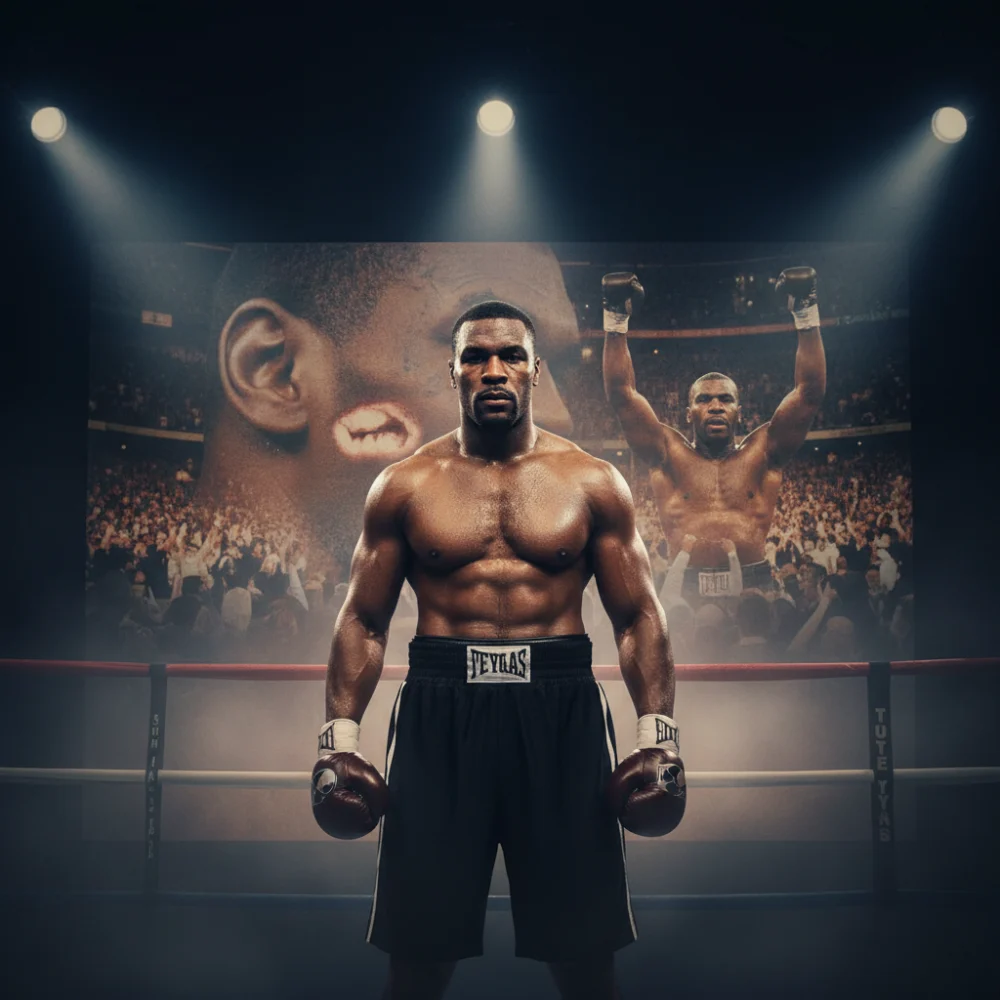
In the annals of boxing history, few names resonate with the same frequency of courage and resilience as Evander "The Real Deal" Holyfield. While many champions are remembered for their knockout power or defensive wizardry, Holyfield carved his legacy through sheer will and an ability to endure punishment that would have shattered lesser men. To understand Holyfield is not merely to look at his record as the only four-time heavyweight champion of the world, but to examine the brutal wars that defined his character inside the squared circle.
Before he became a heavyweight icon, Holyfield had already established himself as one of the greatest cruiserweights of all time. His 1986 battle against Dwight Muhammad Qawi is often cited by purists as his baptism by fire. It was a grueling 15-round affair that pushed Holyfield to the brink of physical collapse, forcing him to lose over 15 pounds of water weight during the fight. This early test proved that Holyfield possessed a "warrior’s heart," a trait that would become the recurring theme of his storied career.
However, the transition to the heavyweight division brought skepticism. Critics argued that Holyfield, a natural cruiserweight, was too small to compete with the giants of the era. Despite winning the undisputed title from Buster Douglas in 1990, the public demanded a true test against a prime, oversized heavyweight. That test arrived in the form of Riddick Bowe, sparking a trilogy that would become the defining saga of the 1990s boxing landscape.
The First War: Holyfield vs. Bowe I
On November 13, 1992, Evander Holyfield stepped into the ring against Riddick Bowe in a fight that would alter the trajectory of his career. Bowe, younger, larger, and possessing immense skill, was seen as the future of the division. The fight was not a tactical chess match; it was a brawl fought in a phone booth. Holyfield, refusing to be bullied by the larger man, chose to stand toe-to-toe, trading heavy leather at close quarters.
The tenth round of this first encounter is widely regarded as one of the greatest rounds in heavyweight history. After being rocked and nearly knocked out by a massive uppercut from Bowe, Holyfield defied physics and logic. Instead of holding on to survive, he fired back, staggering Bowe and turning a near-defeat into a furious exchange of power shots. This specific round encapsulated the essence of Holyfield: a refusal to yield, even when physically outmatched.
Although Holyfield lost the decision and his undisputed title that night, he won something perhaps more valuable: universal respect. The "jumped-up cruiserweight" narrative died the moment he went 12 rounds with Bowe. He proved that while he might lack the raw size of the super-heavyweights, his conditioning and chin were world-class. This loss set the stage for a redemption arc that would captivate the sporting world.
Redemption and the "Fan Man" Incident
The rematch in November 1993 was a different affair, remembered as much for the bizarre interruption by the "Fan Man" (a paraglider who crashed into the ring) as for the boxing itself. Holyfield adjusted his strategy, utilizing more movement and boxing IQ rather than relying solely on brawling. By winning a majority decision, he regained his titles and avenged his only loss at the time, proving he was a master tactician capable of learning from his mistakes.
The trilogy concluded in 1995 with a rubber match that saw a physically depleting Holyfield finally stopped by Bowe. Despite the TKO loss, the series of fights with Bowe remains the cornerstone of Holyfield’s legacy. It demonstrated that he would never back down from a challenge, regardless of the physical toll. However, the boxing world soon believed Holyfield was finished, setting the stage for arguably the biggest upset of the decade.
Conquering the Iron Mike Myth
By 1996, Mike Tyson was back and tearing through the division, reclaiming titles with terrifying ease. When Holyfield signed to fight Tyson, sportsbooks and experts feared for Evander’s health. He was viewed as a washed-up veteran being fed to a prime predator. Yet, Holyfield saw what others missed: Tyson’s reliance on intimidation. Holyfield, forged in the fires of the Qawi and Bowe wars, was incapable of being intimidated.
Holyfield vs. Tyson I was a masterclass in bullying the bully. Holyfield utilized his physical strength in the clinch, pushed Tyson back, and countered with precision. He shocked the world by stopping Tyson in the 11th round. This victory was not just about winning a belt; it was the triumph of mental fortitude over raw aggression. It solidified Holyfield’s status as an all-time great, placing him in the exclusive club of three-time heavyweight champions (at that time).
The subsequent rematch, infamous for the "Bite Fight," further highlighted Holyfield’s composure. While Tyson unraveled mentally and resorted to fouling, Holyfield remained the professional, retaining his title by disqualification. These victories over Tyson proved that Holyfield’s wars with Bowe had prepared him for any level of adversity, hardening him into a fighter who could dismantle the most feared punchers on the planet.
The Late Career and Unification
Even as he aged, Holyfield continued to seek out the toughest challenges. His unification bouts against Lennox Lewis in 1999 were controversial but showcased his longevity. While the first fight was declared a draw (widely seen as a robbery of Lewis), Holyfield performed competitively against a man who was arguably the best heavyweight of the late 90s. He never protected his record; he sought to unify the belts at all costs.
Holyfield’s style was a hybrid of classical boxing and gritty infighting. His ability to throw combinations while moving forward, coupled with a counter-punching ability often underrated due to his willingness to brawl, made him a nightmare matchup. His training regimen, famously dubbed "The Omega Project," ensured that he was always the best-conditioned athlete in the ring, allowing him to maintain a high work rate in the championship rounds.
Ultimately, the war that defined his career was not a single fight, but a continuous battle against the perception of his limitations. From being told he was too small, to being told he was too old, Holyfield answered every critic with his performance in the ring. The Bowe trilogy stands as the physical manifestation of this struggle—a brutal, beautiful display of human will.
Today, Evander Holyfield is celebrated not just for the belts he collected, but for the heart he displayed. In an era of giants like Bowe, Lewis, and Tyson, the smaller Holyfield stood the tallest. His career serves as a blueprint for aspiring fighters, teaching that while skills and power are essential, it is the spirit to endure the wars that truly makes a legend.