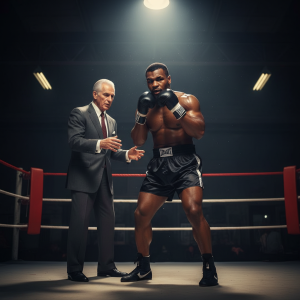

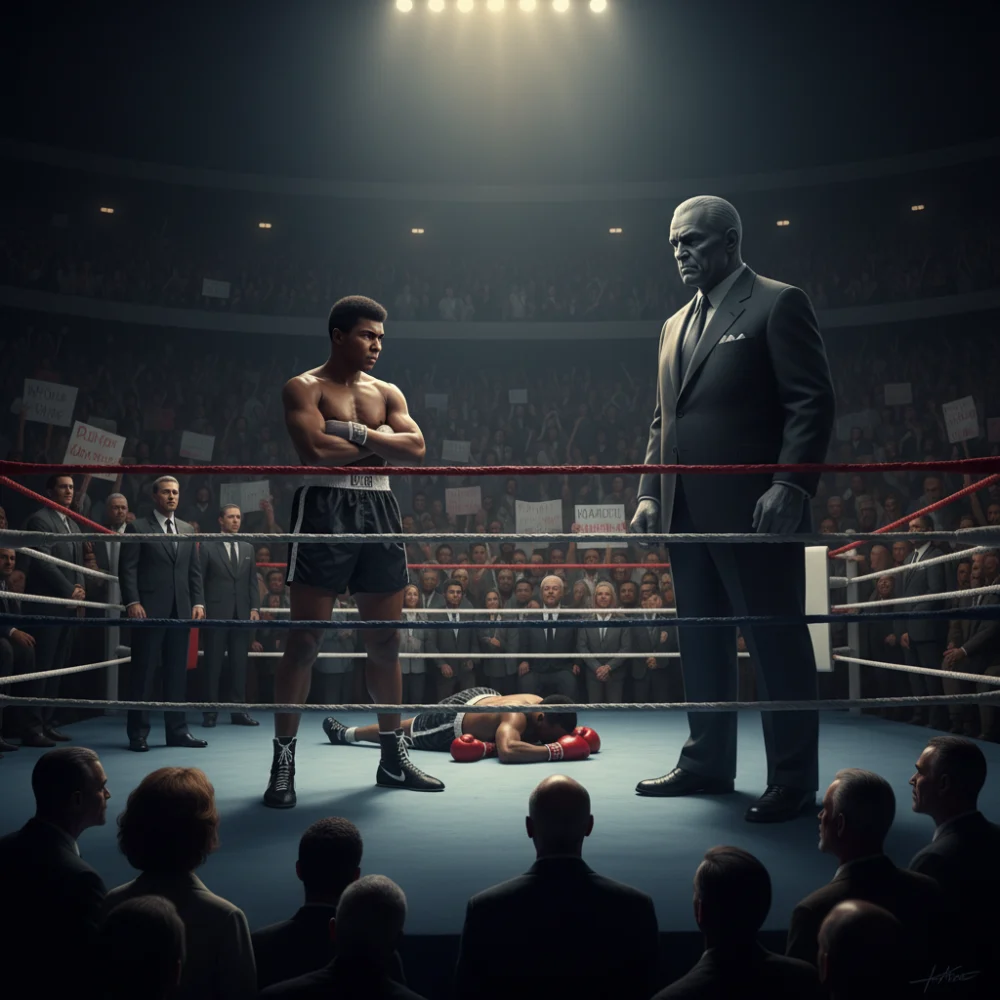
Muhammad Ali is universally recognized as The Greatest in the history of heavyweight boxing. His footwork, his speed, and his charisma inside the squared circle are legendary. However, to define Ali solely by his athletic prowess is to overlook the most significant chapter of his life. His most formidable opponent was not Sonny Liston, Joe Frazier, or George Foreman; it was the United States government and the systemic status quo of the 1960s.
The Context of a Turbulent Era
To understand Ali’s battle against the system, one must understand the volatile climate of 1960s America. It was a decade defined by the Civil Rights Movement, the escalation of the Vietnam War, and a cultural revolution. When Cassius Clay defeated Sonny Liston in 1964 and subsequently announced his conversion to the Nation of Islam, taking the name Muhammad Ali, he immediately positioned himself as a polarizing figure. He was no longer just an athlete; he was a radical voice for Black pride and religious freedom.
In 1966, the conflict in Vietnam was intensifying, and the U.S. military needed more bodies. Ali, who had previously been classified as 1-Y (deferred due to a low score on a qualifying aptitude test), was reclassified as 1-A, making him eligible for the draft. This administrative change set the stage for a collision course between the heavyweight champion of the world and the federal government.
The Refusal Heard Around the World
On April 28, 1967, Muhammad Ali reported to an induction center in Houston, Texas. When his name was called to step forward and be inducted into the U.S. Army, Ali stood still. He refused to step forward three times. He did not dodge the draft by fleeing to Canada; he stood his ground, citing his religious beliefs as a minister of Islam and his conscientious objection to the war.
His justification was simple yet profound, encapsulating the racial tensions of the era. He famously declared, "I ain’t got no quarrel with them Viet Cong." He elaborated that no Viet Cong had ever called him a racial slur, highlighting the hypocrisy of fighting for freedom abroad while Black Americans were denied basic human rights at home. This stance made him a pariah to the establishment and a hero to the counterculture.
The Immediate Consequences
The backlash was swift and severe. Almost immediately after his refusal, the New York State Athletic Commission suspended his boxing license and stripped him of his title. Other commissions followed suit. He was not just an athlete denied a game; he was a man denied his livelihood. He was convicted of draft evasion, sentenced to five years in prison, and fined $10,000. Although he remained free on appeal, his passport was confiscated, preventing him from fighting overseas.
For three and a half years—from March 1967 to October 1970—Ali was exiled from the sport. These were arguably the prime years of his athletic life, from age 25 to 28. In the history of sports, it is unprecedented for a dominant champion to voluntarily sacrifice the peak of their career for a moral principle. He traded millions of dollars and global adulation for the certainty of financial struggle and public vilification.
The Speaking Tours and shifting Tides
During his exile, Ali did not remain silent. Deprived of the boxing ring, he took to college campuses across the nation. He became a captivating speaker, engaging with students who were increasingly disillusioned with the Vietnam War. These speaking tours kept him in the public eye and allowed him to refine his worldview. He spoke about racism, religion, and the absurdity of war, connecting with a younger generation that would eventually help shift public opinion in his favor.
As the body count in Vietnam rose and the war became increasingly unpopular, the public sentiment regarding Ali began to soften. What was once viewed as treason was slowly being recognized as a principled stand. The civil rights movement continued to gain momentum, and Ali stood as a towering symbol of resistance against an unjust system. His sacrifice resonated deeply with those fighting for equality.
The Supreme Court Victory
While Ali eventually returned to the ring in late 1970, his legal battle continued to loom over him. The case, Clay v. United States, eventually reached the Supreme Court. The core of the argument was whether Ali qualified as a conscientious objector. The government had initially argued that his objection was selective (political rather than religious), but Ali’s legal team demonstrated the sincerity of his beliefs derived from the Nation of Islam.
In June 1971, in a stunning unanimous 8-0 decision (Justice Thurgood Marshall recused himself), the Supreme Court overturned Ali’s conviction. The Court ruled that the appeal board had failed to specify why Ali’s application for conscientious objector status was denied, rendering the conviction invalid. It was a monumental victory. Ali had fought the system, risking everything, and he had won.
The Physical Cost of the Layoff
While he won the legal battle, the time away from the ring exacted a heavy physical toll. When Ali returned, the lightning-fast footwork that characterized his early career had diminished. He could no longer dance for 15 rounds without fatigue. He had to reinvent his style, relying more on his granite chin, his psychological warfare, and his ability to absorb punishment—a strategy famously dubbed the "Rope-a-Dope."
Many boxing historians argue that the punishment Ali took in the second half of his career, specifically in bouts against Frazier and Norton, was a direct result of losing his prime defensive years. The system had failed to break his spirit, but the forced hiatus undoubtedly altered the trajectory of his physical health, contributing to the Parkinson’s syndrome he battled later in life.
Legacy of Athlete Activism
Ali’s fight against the system laid the blueprint for the modern athlete-activist. Before Ali, athletes were largely expected to be seen and not heard, to be grateful for their opportunities and silent on political matters. Ali shattered that mold. He proved that an athlete’s platform could be used to challenge societal norms and advocate for justice, regardless of the personal cost.
Today, when we see athletes taking a knee during the national anthem or wearing slogans supporting social justice, we are witnessing the ripples of Ali’s decision in 1967. He normalized the idea that sports and politics are not separate spheres, but rather that the arena is a valid stage for human rights advocacy.
Conclusion: The People’s Champion
Muhammad Ali’s record of 56 wins and 5 losses is impressive, but it is his record of 1 win and 0 losses against the United States government that defines his true greatness. He showed the world that conviction is more valuable than a championship belt. By fighting the system, he transcended the sport of boxing to become a global icon of courage and conscience. He was not just the heavyweight champion of the world; he was, and remains, the People’s Champion.