
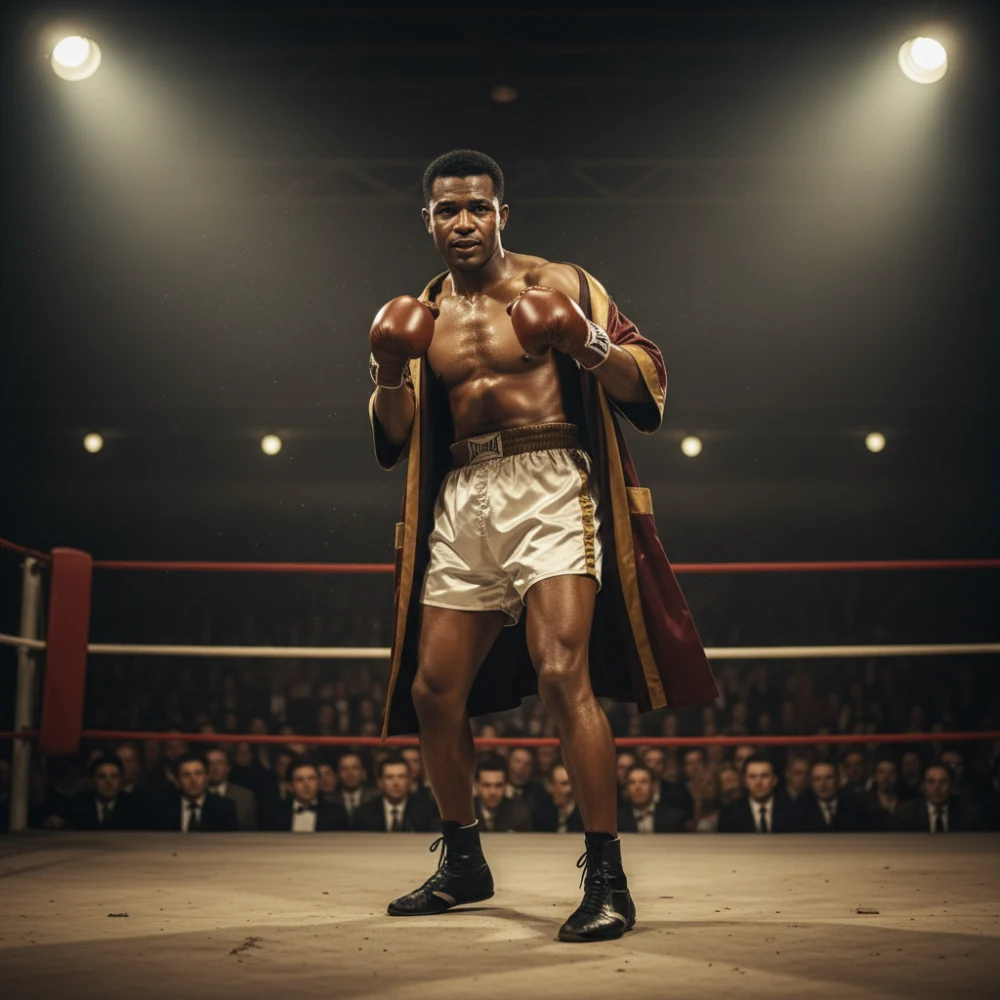
In the endless debates regarding the ‘Greatest of All Time’ (GOAT) in sports, names like Michael Jordan, Tom Brady, and Wayne Gretzky often surface without hesitation. However, in the realm of boxing, the conversation is frequently dominated by the charismatic Muhammad Ali or the undefeated Floyd Mayweather Jr. Yet, if you ask boxing historians, purists, and even Ali himself, the answer is almost always the same: Sugar Ray Robinson.
Born Walker Smith Jr., Robinson was not just a boxer; he was the blueprint for the modern prizefighter. His combination of blinding speed, devastating one-punch knockout power, granite chin, and balletic footwork created a fighter so complete that sports writers had to invent a new term just to classify his dominance relative to his size: pound-for-pound.
The Origin of ‘Pound-for-Pound’
Today, the term ‘pound-for-pound’ is tossed around loosely to market various champions. However, it originated in the 1940s specifically for Robinson. During an era where heavyweights ruled the headlines, Robinson’s skill set in the welterweight and middleweight divisions was so superior to anyone else in the sport—regardless of weight class—that experts needed a linguistic tool to elevate him above the heavyweights. He wasn’t just the best welterweight; he was the best fighter on the planet, period.
An Amateur Pedigree and Professional Perfection
Robinson’s dominance began long before he turned pro. His amateur record is the stuff of legend, reportedly standing at a staggering 85-0 with 69 knockouts, 40 of which came in the first round. This foundation set the stage for a professional career that would see him fight an incredible 200 times.
Upon turning professional in 1940, Robinson embarked on a tear that is statistically incomprehensible by modern standards. At one point in his prime, his record stood at 128-1-2. To put that in perspective, he fought the best contenders of his era repeatedly, often with only weeks of rest between bouts, and remained virtually untouchable for over a decade.
The Jake LaMotta Rivalry
No discussion of Robinson’s greatness is complete without mentioning his defining rivalry with the ‘Bronx Bull,’ Jake LaMotta. The two met in the ring six times, a series of wars that tested Robinson’s grit as much as his skill. While Robinson won five of the six encounters, the rivalry showcased his ability to adapt to a rugged, pressure-fighting style.
The final fight of their series, known as the ‘St. Valentine’s Day Massacre’ in 1951, is a masterclass in brutality and technique. After weathering an early storm, Robinson unleashed a barrage of combinations so severe that the referee had to stop the fight in the 13th round. It wasn’t just a win; it was a statement that finesse could dismantle brute force.
The Perfect Fighting Machine
What made Robinson the greatest was his lack of weakness. Most fighters, even champions, have a flaw—suspect stamina, a drop in power when moving up in weight, or poor defense. Robinson possessed:
- Knockout Power in Both Hands: He could end a fight moving backward with a left hook or moving forward with a right cross.
- Fluidity: His transitions from defense to offense were seamless, often described as ‘sweet’—hence the nickname.
- Chin and Heart: He was never physically knocked out in his 200-fight career (his only stoppage was due to heat exhaustion).
Dominating Two Divisions
Robinson is widely considered the greatest welterweight of all time, a title he held from 1946 to 1951. However, his ambition pushed him to the middleweight division, where he became a five-time champion. This feat was accomplished during an era with only one champion per division, unlike the fractured title landscape of today’s sanctioning bodies.
One of the most telling moments of his career was his challenge for the Light Heavyweight title against Joey Maxim in 1952. Fighting at Yankee Stadium in 104-degree heat, Robinson was dismantling the much larger Maxim on the scorecards. However, the heat proved to be the only opponent Robinson couldn’t beat; he collapsed from hyperthermia after the 13th round. Notably, the referee had already collapsed from the heat earlier in the fight and had to be replaced.
The Eye Test and Modern Comparisons
When watching archival footage of Robinson, what stands out is how modern he looks. His combinations are crisp, his head movement is elusive, and his footwork is efficient. While fighters from the 1940s and 50s often look archaic compared to today’s athletes, Robinson looks like he could step into a ring in 2024 and dominate immediately.
Muhammad Ali, who never shied away from praising himself, always deferred to Robinson. Ali famously called him ‘The king, the master, my idol.’ Sugar Ray Leonard, another legend, admitted that he took the nickname ‘Sugar’ to pay homage to the man who set the standard for excellence.
Legacy Beyond the Numbers
Robinson’s final record of 173 wins, 19 losses, and 6 draws (with 108 KOs) includes a twilight period where he fought well past his prime for financial reasons. However, purists focus on his prime years, where he went on a 91-fight unbeaten streak. This level of consistency against top-tier opposition is why analytical models and historians rank him #1.
Ultimately, Sugar Ray Robinson is the greatest because he combined the art of boxing with the violence of fighting perfectly. He was elegant yet vicious, a celebrity outside the ring and an assassin inside it. For the purist, there is no debate: there is Sugar Ray Robinson, and then there is everyone else.